Is It Safe to Buy a Used PSU in the UK? What You Need to Know
Advertisement
The PSU is the only component in your build that can destroy everything else it's connected to. A failing GPU is an expensive inconvenience. A failing PSU can fry a GPU, motherboard, and CPU simultaneously — or in the worst case, start a fire. That makes it the most safety-critical second-hand purchase you can make.
This guide won't tell you never to buy a used PSU. It will tell you exactly when it's acceptable, when to walk away, how to test what you've bought, and whether new makes more sense than you'd think. For the broader context on which components are risky second-hand, see our UK guide to which PC parts are safe to buy used.
The honest risk assessment
Power supplies fail in ways that are often invisible until they aren't. Unlike a GPU that artifacts visibly before full failure, a PSU can silently deliver dirty power for months before a voltage spike destroys connected components.
Capacitor degradation
The electrolytic capacitors inside a PSU have a finite lifespan — typically 5–10 years under normal conditions, but as little as 3 years under heavy or thermal stress. As they age, they lose capacitance and become less effective at smoothing voltage rails. You won't see this in a quick boot test. The PSU will appear to work fine while delivering noisier, less stable power than spec.
What actually goes wrong
- Voltage rail sag: the +12V rail droops under load, causing system instability, random reboots, or corruption that looks like a software problem.
- Capacitor bulge or leakage: visually detectable in some cases — but not always.
- Fan failure: a PSU that can't cool itself will throttle or cut out, and under extreme stress can thermally strain every component connected to it.
- Bypassed OCP: budget or abused PSUs sometimes have fused or bypassed over-current protection circuits — meaning a downstream fault won't be interrupted before damage spreads to other parts.
None of this means “don't buy used.” It means “know what you're evaluating.” A well-specced PSU from a reputable brand, under 3 years old, with documented usage, is a completely reasonable purchase. A mystery unit from an unknown seller is not.
When a used PSU is acceptable to buy
All six criteria below should ideally be met. The more you can confirm, the safer the purchase. Miss several, and you've moved from managed risk to a gamble.
- Under 3 years old — primary capacitors are still well within spec at this age. Ask for proof of purchase or a receipt; most sellers of quality PSUs keep this. Under 5 years is the outer limit for a confident buy.
- Reputable brand — Seasonic, Corsair (RM/RMx/HX series), be quiet!, EVGA SuperNOVA, and Fractal Ion all use high-grade capacitor suppliers with consistent quality control. Budget no-name PSUs cut costs precisely at the cap-quality level.
- 80+ Gold or Platinum rated — not because efficiency matters to you directly, but because 80+ ratings above Bronze require stricter quality thresholds for internal components. Gold is where quality becomes predictable.
- Not from a mining rig — mining PSUs run at 60–80% load continuously, 24/7. This ages capacitors dramatically faster than gaming. A mining PSU that's 18 months old may be equivalent in wear to a 4–5 year normal-use unit.
- Clear close-up photos provided — ask for a photo of the capacitors on the primary side (the large cylindrical components near the AC input). You're looking for flat tops, no visible dome, and no brown residue around the base.
- Seller discloses usage history — a trustworthy seller will tell you what system it was in, approximate hours of use, and why they're selling. “System upgrade” or “changing to modular” are reasonable reasons. Vague answers about “just clearing out parts” warrant follow-up questions.
Red flags: when to walk away
Each item below is a standalone reason to skip a listing. You don't need multiple flags before walking away — one serious red flag is enough.
Unknown age
If the seller has no idea how old the PSU is, you have no way to assess capacitor health. Age is the single most important variable — without it, the rest of the evaluation is guesswork.
Mining rig history
Continuous 70%+ load 24/7 ages PSU components dramatically faster than normal gaming. A 2-year mining PSU is meaningfully older in wear than a 4-year gaming PSU.
Burned plastic smell
Any scorch odour from the unit suggests thermal events that could have damaged internal components. This is an immediate no under any circumstances.
"Powers on but…" disclaimers
Any variation on "powers on but occasionally shuts off", "works fine most of the time", or "not totally sure why I'm selling" describes instability. The seller is telling you something is wrong.
Budget brand no-names
Units without a traceable brand, or extreme budget brands common on AliExpress or Amazon Marketplace, have no obligation to meet their rated specs. Some fail immediately; others fail catastrophically.
Visibly swollen capacitors
If the seller provides an internal photo and any large capacitors show a domed top instead of a flat top, the unit is degraded and should not be purchased at any price.
Age 5+ years
Even quality PSUs from reputable brands approach their capacitor lifespan ceiling at 5–7 years under normal use. A 6-year Seasonic for £40 is a harder call than it first appears — the savings rarely justify the risk.
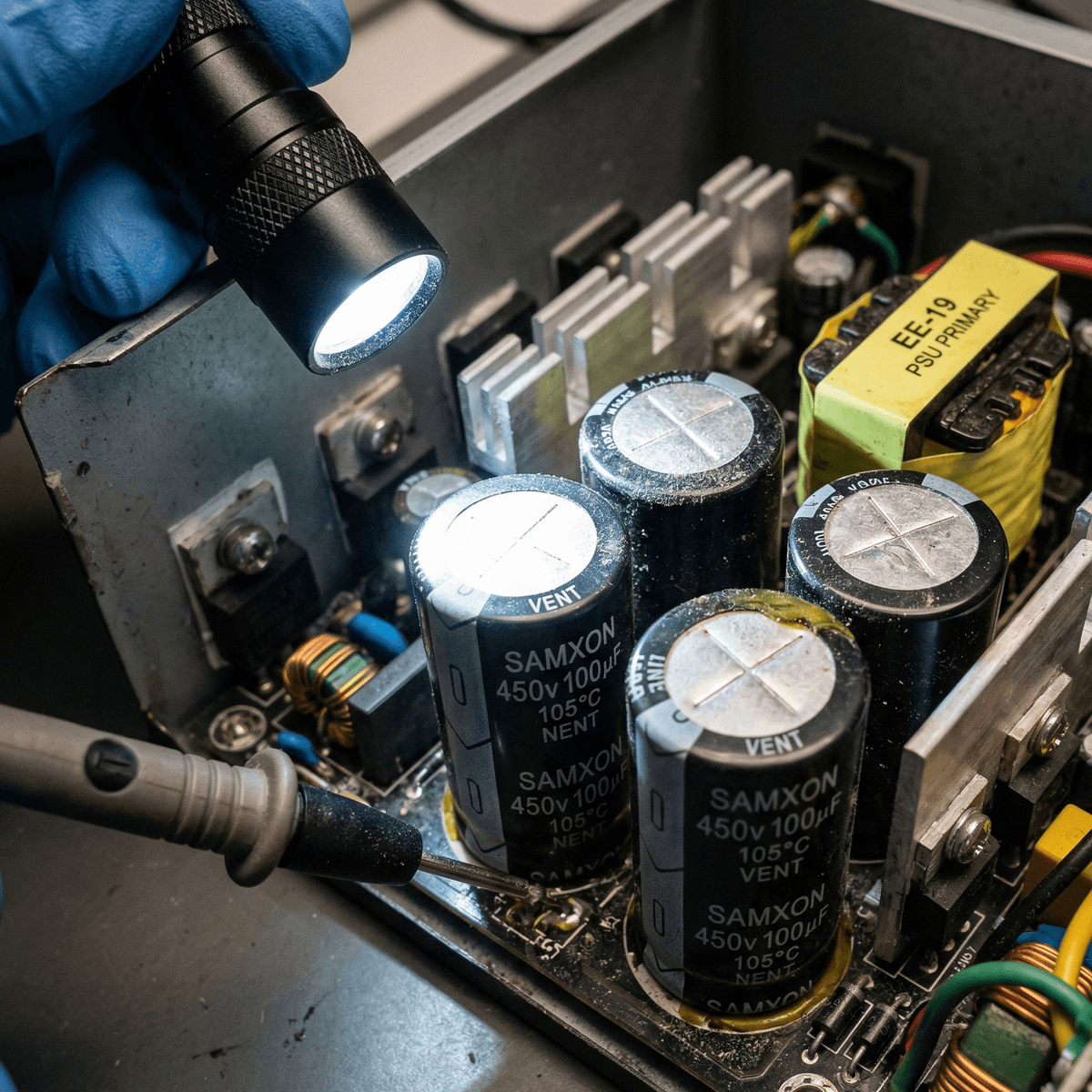
Primary-side capacitors should have flat tops. Domed, bulging, or leaking caps are an immediate red flag.
Best used PSUs to consider in the UK (2026)
These are the models worth targeting when buying second-hand. They reflect the brands where commitment to capacitor quality, warranty heritage, and UK market availability combine to make a used example meaningful — not a risk transfer.
Seasonic Focus GX-650
~£55 used10-year warranty on new units signals deep cap-quality confidence. Japanese primary capacitors. Semi-fanless mode means the fan doesn't start until load reaches ~40%, reducing thermal stress in lighter use and extending fan life.
Corsair RM750x
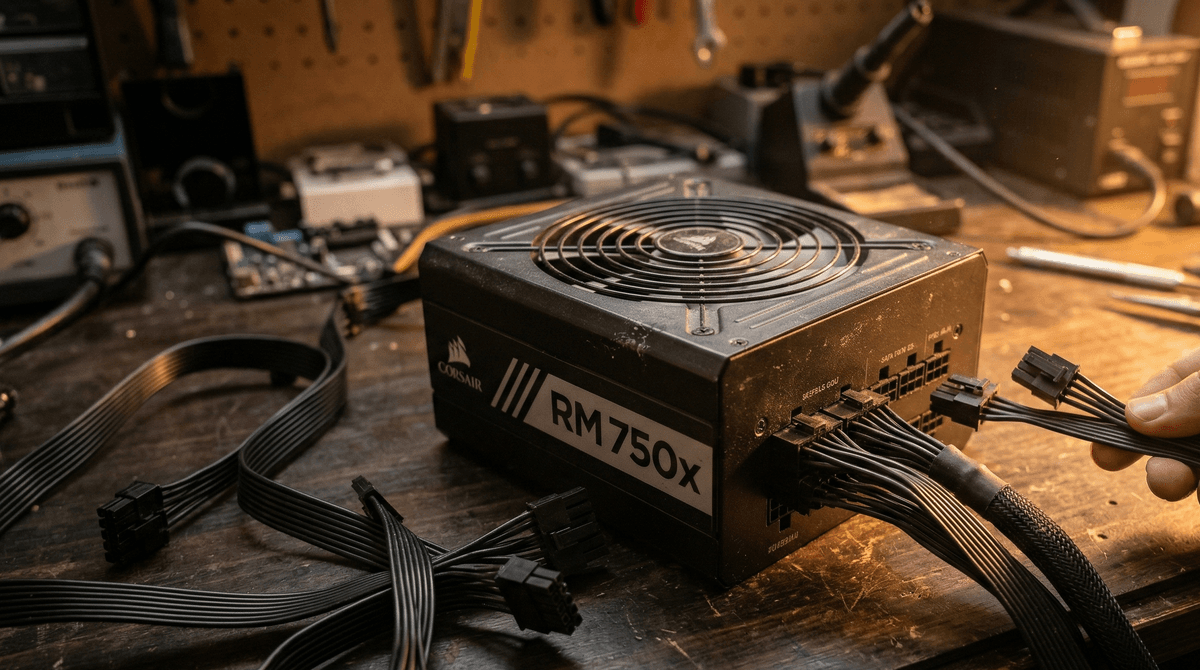
~£50 usedJapanese 105°C capacitors throughout, fully modular, quiet semi-passive operation. The RM/RMx line has a well-earned reputation for clean, stable rails. Target 2018 models or newer.
be quiet! Straight Power 11 650W
~£45 usedQuiet by design with Active Clamp + SR topology for excellent voltage regulation. Well-regarded across the UK enthusiast market. 5-year warranty on new units.
EVGA SuperNOVA 650 G5
~£45 used10-year warranty on original new units, Japanese caps, fully modular. Note: EVGA exited the GPU and PSU market — active UK warranty support no longer exists. Factor this into your pricing expectations.
If none of these are available at a price that makes sense, buying new is often the right call. A new 80+ Gold PSU from a reputable brand can be found under £70 in the UK — not dramatically more than the used examples above, and with full warranty.
How to test a used PSU before full system use
Never connect a used PSU directly to your main build without at least one basic test first. These tests won't catch slow capacitor degradation, but they will catch immediately dangerous units and out-of-spec rails.
Option 1: PSU tester (recommended, £8–15)
A basic ATX PSU tester connects to the 24-pin motherboard connector and displays whether each rail is within spec. It's the fastest go/no-go check available. Expect to see the +12V, +5V, and +3.3V rails live on a small LCD display.
- +12V should read 11.4V–12.6V.
- +5V should read 4.75V–5.25V.
- +3.3V should read 3.135V–3.465V.
- Any reading outside these ranges under no-load testing indicates a problem that will be worse under load.
Option 2: The paperclip test (free, manual)
Do this only with the PSU unplugged from all system components. Bridge the green wire (PS_ON, pin 16) and any black wire (ground) on the 24-pin connector using a bent paperclip. When connected to mains power, the PSU fan should spin and the unit should stay on. This confirms the unit can self-start, but tells you nothing about rail quality or stability.
Important: run the paperclip test with nothing else connected — no drives, no GPU, no motherboard. It confirms start-up function only.
Option 3: Multimeter rail test (most thorough)
If you have a multimeter and access to a test bench or spare system, power the PSU with a minimal load (motherboard + CPU only) and probe the rails. Then add a discrete GPU or additional drives to increase load. Voltage should hold stable throughout — ideally within 2–3% of spec.
- Measure the +12V rail on a spare SATA power connector (yellow wire to black wire).
- If the +12V drops below 11.5V under moderate load, the unit is underperforming.
- Noisy or fluctuating readings (when the meter itself isn't the issue) signal cap degradation.
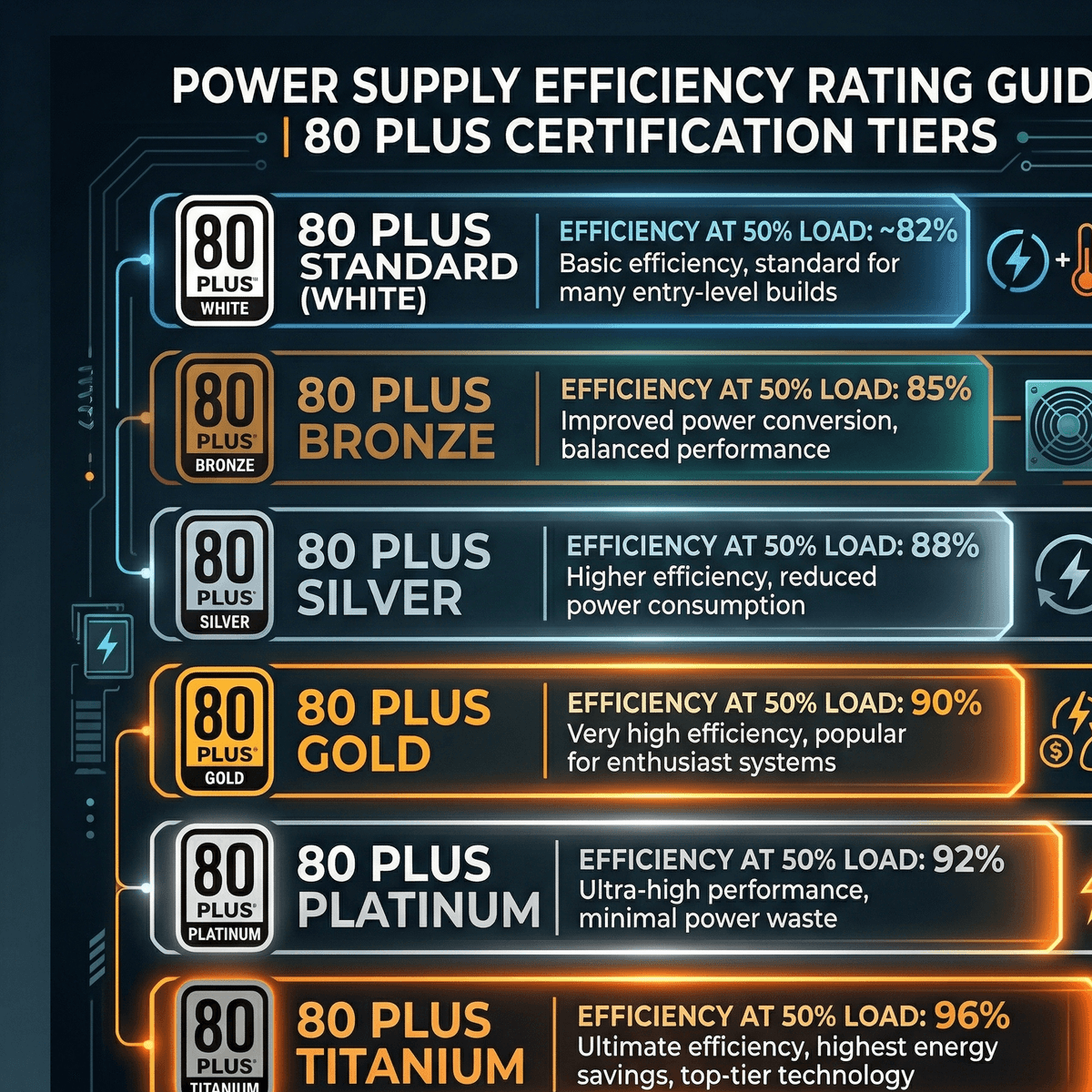
80+ Gold is the minimum worth targeting for any used PSU buy in 2026. Gold and above reliably correlates with better internal component quality.
Wattage guide for 2026 builds
Beyond whether the PSU is safe, you need the right wattage for your system. Running a PSU at or near its rated capacity is a fast way to stress it further — and with a used unit, that headroom margin is already narrower than new.
Office / light-use system (iGPU or low-end dGPU)
Leaves ample headroom; fan likely stays silent most of the time.
Mid-range gaming: Core i5 / Ryzen 5 + RTX 3060 or RX 6650 XT
Minimum. 650W preferred to maintain headroom.
High-end gaming: Core i7 / Ryzen 7 + RTX 3070 or RX 6800 XT
650W minimum; 750W is more comfortable.
Performance gaming: i7/i9 or Ryzen 9 + RTX 4070 or 4070 Ti
Don't undershoot — RTX 4070 Ti can spike to 285W under load.
Enthusiast: i9 / Ryzen 9 + RTX 4080 or 4090
RTX 4090 alone can spike to 450W+. 12VHPWR cable required. 1000W Gold+ only.
These figures assume a single GPU, standard air cooling, and typical storage. Add 50–100W for heavy overclocking, additional drives, or multiple case fans on a high-airflow setup.
New vs used: when paying more makes sense
A PSU is one of the few components where “just buy new” is often the correct answer, and the cost difference is smaller than most people expect.
The case for buying new
- A new Corsair CV650 (80+ Bronze) costs around £55–65 in the UK. It's not Seasonic-quality — but it's new, under full UK manufacturer warranty, and hasn't aged a single day.
- A new be quiet! Pure Power 12 650W (80+ Gold) typically retails at £75–85. Compared to a £45–55 used example with unknown capacitor hours, that £25–30 premium looks increasingly justified.
- A new PSU comes with full manufacturer warranty — typically 3–7 years — a meaningful assurance when you're protecting a system worth hundreds or thousands of pounds.
When used makes sense
- The unit is under 3 years old, from a premium brand (Seasonic Focus GX, Corsair HX), available at 40–50% below new — a real saving on a component that originally cost £100+.
- You need to source quickly and a known-good unit from a local verified seller is available with disclosed usage and meeting all six criteria above.
- You're building a short-term or secondary machine where the downside risk is contained and a failure is an inconvenience rather than a catastrophe.
For your main gaming build — especially with a high-end GPU — the PSU is the last place to recover a blown budget. Protect the rest of your investment. For broader advice on building within a budget, see: cheap gaming PC build UK 2026.
FAQs: buying a used PSU in the UK
Is it safe to buy a used PSU in the UK?
It can be — but only under a clear set of conditions: known age (under 3 years ideally), reputable brand, 80+ Gold or better, no mining history, and a seller willing to disclose usage. Without these, the risk is high enough that a new budget PSU is the smarter choice. Browse available used PSUs on Koukan's UK used parts marketplace.
How long do PSUs actually last?
Quality PSUs from reputable brands are typically rated for 50,000– 100,000 hours at rated temperature — roughly 10–12 years of normal gaming use at 4–6 hours per day. Capacitor lifespan is the limiting factor. Continuous high-load use (such as mining or 24/7 folding) or elevated ambient temperatures substantially reduce this figure.
What's the minimum 80+ rating worth buying used?
80+ Bronze is technically acceptable for a low-risk used buy if the unit is young and from a reputable brand. In practice, target 80+ Gold and above when buying second-hand — the quality correlation is meaningfully better, and the used price difference between Bronze and Gold is typically only £5–10.
How can I tell if PSU capacitors are bad without opening it up?
You often can't judge from the outside alone. The most practical approach is to test rail voltages under load with a PSU tester or multimeter. Out-of-spec or fluctuating readings under even moderate load indicate capacitor degradation. Other symptoms include random system reboots, unexplained instability, and a PSU fan that runs louder than expected even under light load.
Should I buy a used PSU for an RTX 4080 or 4090 build?
No. High-end GPUs make the PSU the single highest-stress component in the build during peak load spikes. A failing PSU under RTX 4090 draw can destroy a multi-thousand-pound investment in seconds. For a build at this level, buy new, buy 1000W Gold or Platinum, and do not compromise. This is the one place where the safety margin is worth every penny.
Find a vetted used PSU on Koukan
If you're looking for a used PSU in the UK that meets the criteria in this guide, Koukan is the UK's dedicated second-hand PC parts marketplace. Listings are from UK sellers, with part-level categories so you can filter by component type and condition — and message sellers directly to ask the questions this guide recommends.
For the broader playbook on safe second-hand purchases, start with our complete guide to buying used PC parts in the UK. And if you're weighing up whether used is right across your whole build, read: is it safe to buy used PC parts in the UK?
Advertisement