Used PC Parts & Consumer Rights in the UK: What Buyers Need to Know (2026)

Advertisement
The UK used PC parts market is worth billions—and most buyers don't know the legal protections they already have. The Consumer Rights Act 2015, distance selling regulations, and payment-method laws mean that buying from the right seller in the right way gives you real, enforceable rights—not just goodwill.
This guide covers every layer of UK consumer protection for used electronics: what the law says, which rules apply when, and exactly what to do if something goes wrong. If you want the scam-prevention side, start with how to avoid scams buying used PC parts online. For the safety fundamentals, see is it safe to buy used PC parts in the UK?
Full Consumer Rights Act protection: 30-day right to reject, 6-month repair/replace rule, up to 6 years to claim.
Fewer statutory rights—but fraud and misrepresentation are still illegal, and payment methods add a second layer.
Your payment method is a second legal safety net. Credit card Section 75 rights exist regardless of whether the seller is a business or private individual.
Disclaimer: This is general guidance, not legal advice. For specific disputes, consult Citizens Advice or a qualified solicitor.
The Consumer Rights Act 2015: what it says about used goods
The Consumer Rights Act 2015 is the primary UK statute governing consumer purchases. It applies when you buy goods from a business seller—including sole traders, registered companies, and anyone operating commercially. It sets three core standards that goods must meet, regardless of whether they are new or second-hand.
The goods must match their description. A listing that says "RTX 3080" must be exactly that. Any departure from the listed specs is a breach.
The goods must do what goods of that type are reasonably expected to do. A used GPU that fails to output video is not fit for purpose.
Goods must be of a standard a reasonable person would consider satisfactory, taking account of any description, the price, and any other relevant circumstances—including that they are second-hand.
Your time-limited remedies
If the goods are faulty, you can reject them and demand a full refund within 30 days of purchase. The seller cannot insist on a repair first during this window.
Within the first 6 months, a fault is presumed to have existed at the time of sale. The seller must repair or replace, and if they can't, you're entitled to a partial or full refund.
In England and Wales, you have up to 6 years from the date of purchase to bring a claim in the courts. After 6 months you must prove the fault existed at the time of sale.
A critical point: these rights apply in addition to any warranty or guarantee the seller advertises. You can't be asked to waive them.
Private seller vs business seller: the key distinction
This is the most important division in UK used-parts law. Business sellers must comply with the Consumer Rights Act in full. Private sellers—individuals selling items they genuinely own for personal use—operate under a different (and weaker) framework.
Buying from a business
- Full Consumer Rights Act 2015 protections apply.
- Distance selling (14-day cooling-off) if bought online.
- Goods must be as described, fit for purpose, satisfactory quality.
- Trading Standards can investigate serious non-compliance.
Buying from a private seller
- Consumer Rights Act does not apply. "Buyer beware" (caveat emptor) governs.
- No cooling-off or distance selling rights.
- Fraudulent misrepresentation and false advertising are still illegal under the Misrepresentation Act 1967.
- Payment method protections (Section 75, PayPal) still apply regardless.
How to tell: a seller who lists multiple items, runs a web shop, or clearly operates commercially is likely a business seller even if they call themselves "private". Volume of listings and consistent commercial language are key indicators. Platforms like eBay will flag verified business sellers.
Distance selling rules: the 14-day cooling-off right
The Consumer Contracts (Information, Cancellation and Additional Charges) Regulations 2013 give you a 14-day right to cancel any online or distance purchase from a business seller—no reason required. This applies even to second-hand goods bought online.
Applies when…
- You buy online or by phone from a business seller.
- The contract is concluded at a distance (seller and buyer not in the same location).
- The item is a physical good (not a digital product).
Does NOT apply when…
- You buy from a private seller (individual, not trading).
- You buy in person at a physical shop or market stall.
- The item is bespoke/customised at your request.
How to exercise it: notify the seller in writing that you're cancelling within 14 days of receiving the goods. You may be responsible for return postage unless the seller offers free returns or the item is faulty.
Payment method protections: your second legal safety net
Even when Consumer Rights Act protections don't apply (for example, a private seller), your payment method may still give you a route to recover money. This is one of the most underutilised protections in UK used-parts buying.
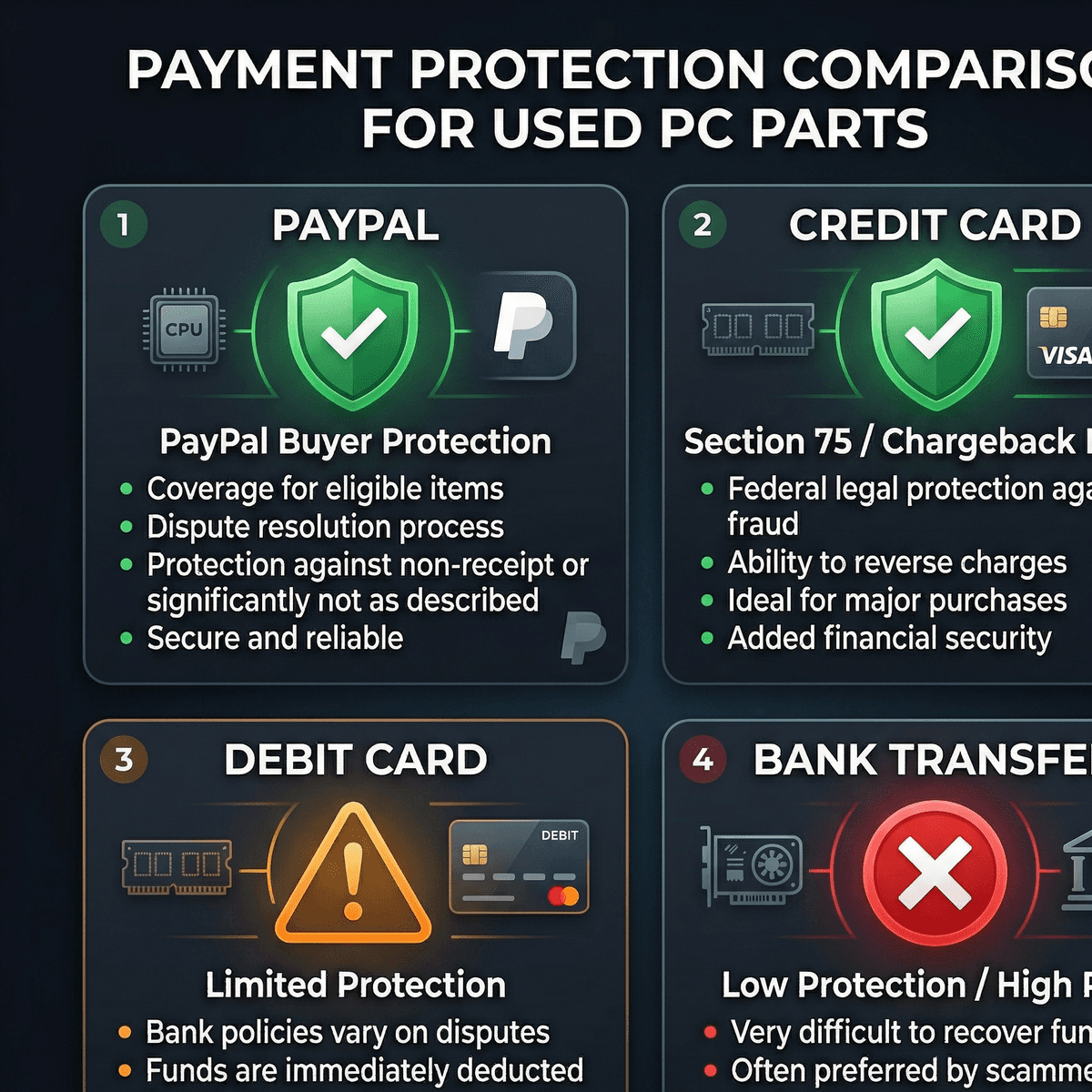
Your protection level is set the moment you choose how to pay.
Credit card — Section 75
Statutory rightUnder Section 75 of the Consumer Credit Act 1974, your credit card issuer is jointly liable with the seller for purchases between £100 and £30,000. This means you can claim against your bank if the seller won't respond—regardless of whether the seller is a business or private individual.
- Claim window: up to 6 years.
- Works even if the seller has disappeared or gone bust.
- Must be a direct transaction (not through PayPal or a third-party processor to qualify).
PayPal Buyer Protection
Contractual rightPayPal's Buyer Protection covers items that are "significantly not as described" or fail to arrive. You have up to 180 days from the payment date to open a dispute.
- Must pay via Goods & Services—not Friends & Family.
- Covers private and business sellers.
- Keep all listing screenshots, tracking info, and test evidence before filing.
Debit card chargeback
Voluntary schemeChargeback is a voluntary scheme operated by card networks (Visa, Mastercard). It is not a statutory right, but your bank can reverse a transaction if the goods were not as described or the seller breached their contract.
- Typical window: 120 days from the transaction date.
- Apply through your bank's dispute team.
- Evidence of the fault and seller non-response strengthens the claim.
Bank transfer
No protectionBank transfer (BACS/Faster Payments) offers no buyer protection. Once the money is sent, you rely entirely on the seller's goodwill or the courts to recover it.
- Avoid bank transfer for posted purchases where you cannot inspect first.
- If collecting in person and testing on the spot, it is lower risk.
Platform-specific buyer policies
Beyond the statutory framework, the platform you buy on sets its own policies on top. These complement—and sometimes exceed—your legal rights, but they cannot remove them.
Koukan
RecommendedBuyer protection is built into the platform fee. Koukan covers purchase disputes and DOA (dead on arrival) claims through a managed process. All listings are PC-parts specific—descriptions are standardised, reducing the "as described" disputes that are common on general marketplaces.
eBay
Strong protectionThe eBay Money Back Guarantee covers most used items for 30 days from delivery. It applies to items "not as described" and non-arrivals. Business sellers on eBay are also subject to the Consumer Rights Act—eBay enforces return policies accordingly.
Facebook Marketplace
No protectionFacebook Marketplace has no integrated buyer protection for most C2C sales. Most transactions are cash in person—meaning no payment protection and no platform dispute process. Your only recourse is the law and your payment method.
Gumtree
No protectionGumtree operates as a classified-ads directory with no payment processing and no buyer protection. Disputes are entirely between buyer and seller. Use only for in-person collection where you can test before paying.
For a full comparison of platforms by fee, protection, and audience, see Koukan vs eBay vs Facebook Marketplace.
What "sold as seen" actually means legally
"Sold as seen" is a phrase used frequently in second-hand listings—but its legal weight depends entirely on who you're buying from.
Business seller: limited effect
A business seller cannot use "sold as seen" to override the Consumer Rights Act. Stating "sold as seen" in a listing does not remove your rights to goods that are as described, fit for purpose, or of satisfactory quality. The phrase has no legal force against consumer rights.
Exception: if you physically inspect specific defects before buying, those defects cannot later be claimed as unexpected—this is what "sold as seen" legitimately captures.
Private seller: more limiting
For private sellers, "sold as seen" carries more weight because the Consumer Rights Act doesn't apply. You are expected to inspect and ask questions before buying—and accepting an "as seen" condition limits what you can claim later for general wear and imperfections.
However: even a private seller cannot hide known faults from you. Deliberate concealment of a defect or a false description is fraudulent misrepresentation under the Misrepresentation Act 1967—which is both a civil and potentially criminal matter.
What to do when a used PC part fails: step-by-step
Acting in the correct order keeps every door open. Opening a chargeback before contacting the seller, for example, can cause the platform to rule against you. Follow these steps in sequence.
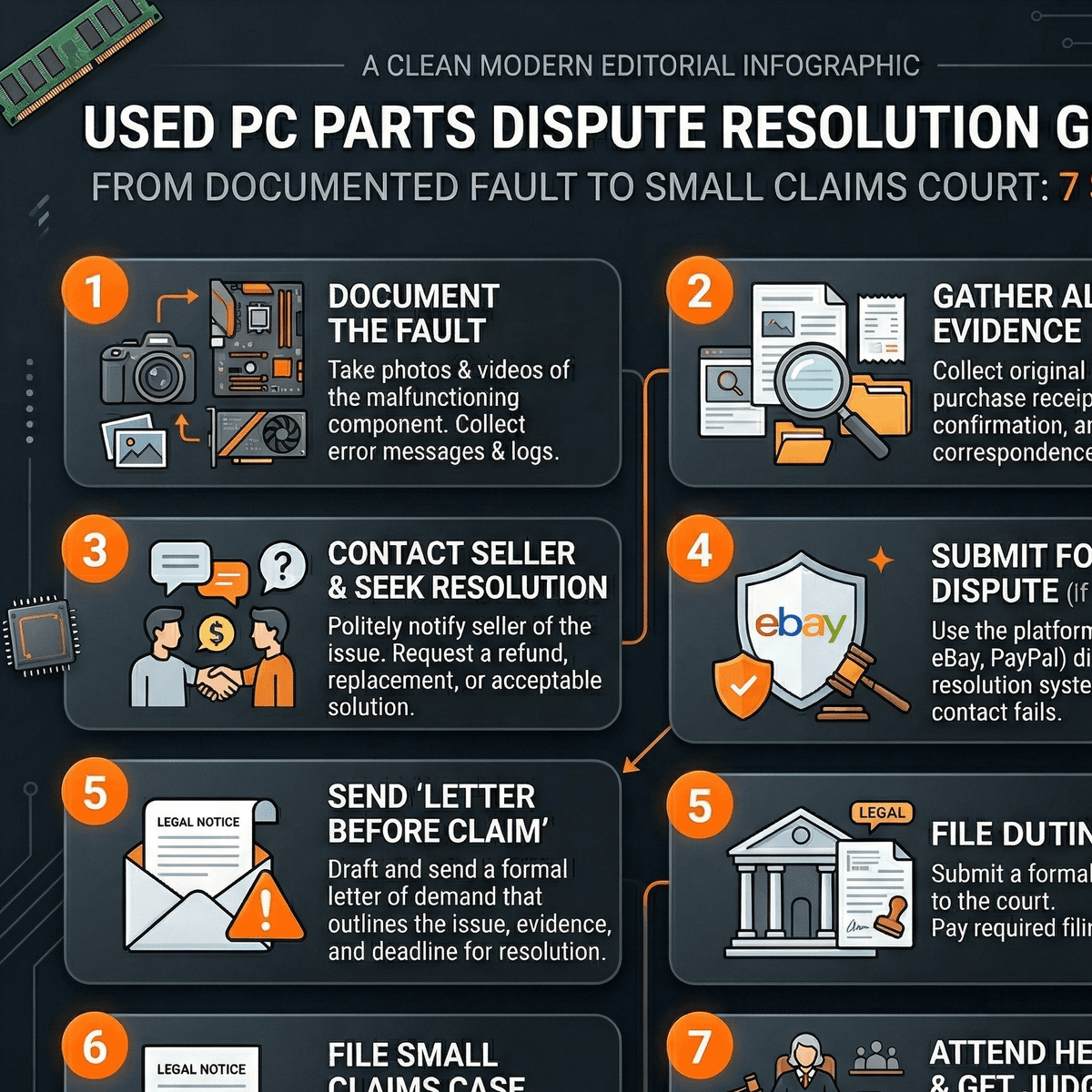
Each step preserves the next — don't skip ahead.
- Document the fault. Record a clear video of the issue. Photograph any physical damage, take screenshots of error messages, save benchmark or diagnostic output. Time-stamp everything. This evidence is required at every subsequent stage.
- Contact the seller in writing. Send a message through the platform's messaging system (keeps a time-stamped record). State the fault clearly, reference the listing description, and request a repair, replacement, or refund. If a business seller, you can cite the Consumer Rights Act 2015.
- Allow a reasonable response window. For online transactions, 5–7 working days is reasonable. Keep records of all communication—including if they don't respond.
- Escalate to the platform. If the seller doesn't resolve the issue, open a formal dispute through the platform (eBay Money Back Guarantee, Koukan dispute process, PayPal Resolution Centre). Provide all your documented evidence.
- Credit card chargeback or PayPal escalation. If the platform dispute is exhausted or doesn't apply, contact your card issuer for a chargeback (debit card) or invoke Section 75 of the Consumer Credit Act 1974 (credit card). Include your documented evidence and proof that you attempted resolution with the seller.
- Trading Standards / Citizens Advice. For business sellers who refuse to comply with the Consumer Rights Act, report to Trading Standards via Citizens Advice. This is also the appropriate route for fake or mislabelled products (e.g. GPU counterfeits).
- Small Claims Court (Money Claim Online). For disputes under £10,000, the small claims track in England and Wales is designed to be used without a solicitor. Use Money Claim Online (gov.uk) to file. This is most practical for higher-value parts where the effort is justified.
Key principle: evidence degrades over time. The sooner you test, document, and open a dispute, the stronger your position. Time windows (30-day right to reject, 120-day chargeback window, 180-day PayPal window) are strict—once missed, they cannot be reopened.
Scam patterns and the law: what qualifies as fraud
Most disputes in used PC parts are commercial disagreements. But some cross into illegal territory. Knowing the distinction affects which channels you use and how urgently you act.
Fake specifications
A seller who knowingly lists an RTX 3070 as an RTX 4080 is committing fraudulent misrepresentation. This is both a civil claim (under the Misrepresentation Act 1967) and potentially criminal (Fraud Act 2006). Report to Action Fraud (actionfraud.police.uk) and Trading Standards.
Counterfeit or rebadged GPUs
Counterfeit hardware—GPUs with tampered BIOS or relabelled chips—is a Trading Standards matter. It may also engage the Consumer Protection from Unfair Trading Regulations 2008. Report to Citizens Advice consumer helpline, who refer to Trading Standards.
Non-delivery after payment
Failure to deliver an item after receiving payment is not just a civil dispute—if it was intentional, it is fraud by false representation under the Fraud Act 2006. Report to Action Fraud and escalate through your payment provider immediately.
Deliberate concealment of faults
A seller who knows a GPU has died pixels, a PSU has capacitor damage, or an SSD is failing—and lists it as "good working condition"—is concealing a material fact. This is actionable as misrepresentation under both civil and, where dishonest, criminal law.
For practical scam-avoidance before you buy, the full prevention guide is at how to avoid scams buying used PC parts online.
FAQ: consumer rights for used PC parts in the UK
Can I return a used PC part bought online?
If you bought from a business seller online, yes. You have a 14-day right to cancel under the Consumer Contracts Regulations 2013 (no reason needed), plus a 30-day right to reject a faulty item and get a full refund under the Consumer Rights Act 2015. Private sellers are not legally required to accept returns unless the item was misrepresented.
What if the listing said "sold as seen"?
For business sellers, "sold as seen" does not override the Consumer Rights Act. Your right to goods that are as described, fit for purpose, and of satisfactory quality remains intact. For private sellers, it limits your options for general wear but doesn't protect deliberate concealment of known faults—that's fraudulent misrepresentation.
Does PayPal really cover used PC parts?
Yes—PayPal Buyer Protection covers items significantly not as described for up to 180 days from payment, for goods bought via Goods & Services (not Friends & Family). Keep all listing screenshots, tracking info, and fault evidence ready before you file.
What is Section 75 and does it apply here?
Section 75 of the Consumer Credit Act 1974 makes your credit card issuer jointly liable for purchases between £100 and £30,000 where the seller breaches their contract or commits misrepresentation. It applies to used goods bought on a credit card. The important caveat: the transaction must be direct—routed through a third-party processor like PayPal typically breaks the direct connection required for Section 75.
When should I use the Small Claims Court?
Small Claims is practical for disputes under £10,000 once you've exhausted platform and payment-provider routes. Use Money Claim Online at gov.uk. You don't need a solicitor. It's best suited to business sellers who refuse to honour your legal rights—the threat of a formal claim often resolves disputes before the court date.
Buy used PC parts with protection built in
Knowing your rights is the first line of defence—but choosing a platform designed for PC parts buyers means fewer disputes in the first place. Koukan listings are structured, condition-rated, and include buyer protection as standard. Every purchase is backed by a dispute process that sits on top of your statutory rights, not instead of them.
Continue building your buying framework: buy used PC parts safely in the UK covers the full pre-purchase workflow, and is it safe to buy used PC parts in the UK? gives you the risk-scoring model.
Shop with protection on Koukan
Verified listings, PC-specific condition ratings, and a dispute process for every purchase.
Disclaimer: This article provides general guidance on UK consumer rights and is not legal advice. For specific disputes, consult Citizens Advice (citizensadvice.org.uk) or a qualified solicitor. Laws referenced: Consumer Rights Act 2015, Consumer Contracts (Information, Cancellation and Additional Charges) Regulations 2013, Section 75 Consumer Credit Act 1974.
Advertisement