10 Best Used GPUs to Buy in 2026: Ranked by Value
Advertisement
The UK used GPU market in 2026 is the best it has ever been. NVIDIA's RTX 50-series launch has pushed older cards into a price free-fall, and AMD's aggressive discounting on current-gen has made the second-hand tier below even cheaper. If you want more frames for fewer pounds, right now is the time to buy used.
We ranked every commonly available used graphics card in the UK by a single question: how much real gaming performance do you get per pound spent? Then we filtered for reliability, VRAM headroom, and actual availability on UK platforms—eBay, Facebook Marketplace, and dedicated marketplaces like Koukan.
The result is a ranked top 10 that covers every budget from £55 to £410. Whether you are building a budget esports rig or a no-compromise 1440p machine, there is a card here for you. For the full buying process—how to spot fakes, negotiate, and test—read our complete guide to buying a used GPU in the UK. If you are still weighing the general pros and cons, start with are used GPUs worth buying in 2026?
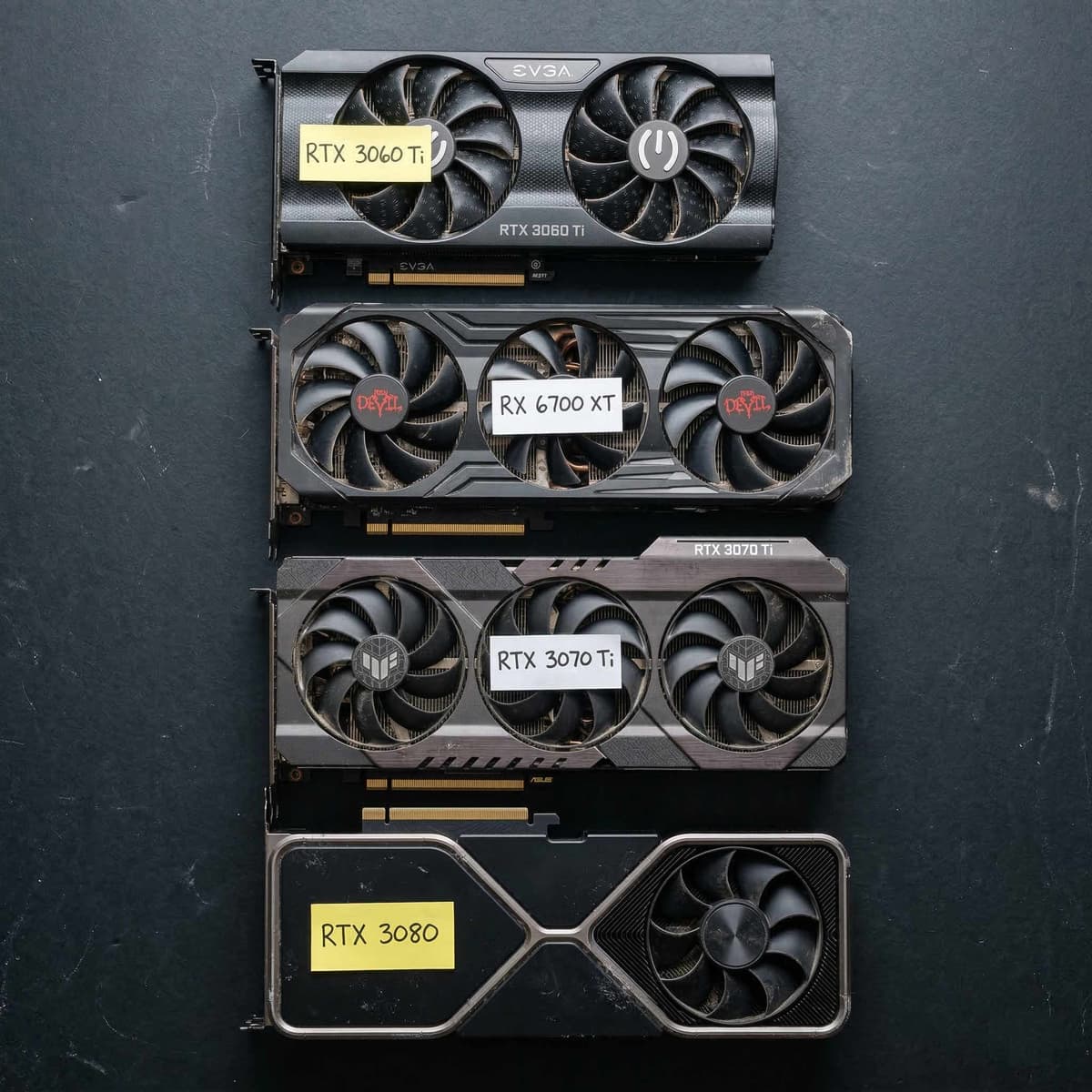
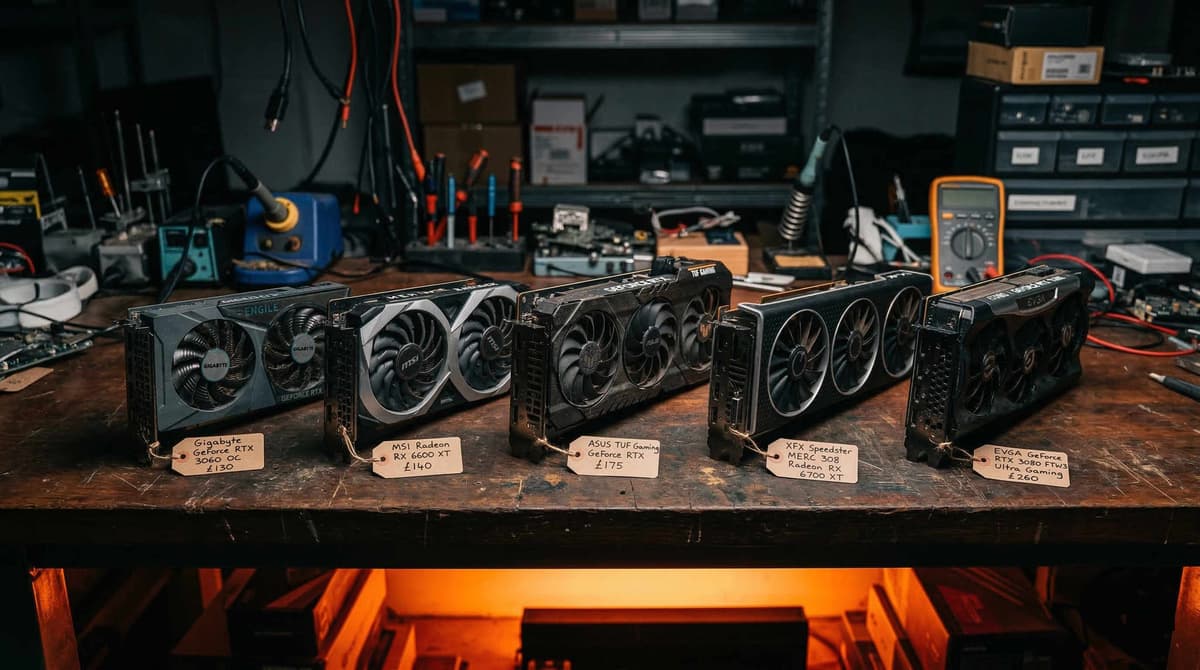
Our ranked lineup—sorted by value per frame, not raw performance.
The 10 best used GPUs in 2026, ranked
Every card below was evaluated on four criteria: cost per frame at its target resolution, UK used-market availability, reliability track record, and VRAM adequacy heading into late 2026. Prices reflect actual completed UK listings at the time of writing.
NVIDIA RTX 3070
1080p Ultra / 1440p HighThe RTX 3070 is our number-one pick because nothing else on the UK used market delivers this much performance for under £220. It trades blows with the RTX 2080 Ti—a card that launched at over £1,000—yet you can pick one up for the price of a pair of trainers.
At 1080p you will be running virtually every title on Ultra settings well above 60 fps. At 1440p, drop a setting or two and you are still comfortably above 60 in demanding AAA games. DLSS 2 support extends its life further, and the Ampere architecture is mature and well-understood by driver teams.
The only real caveat is the 8 GB VRAM buffer. For 1080p and 1440p in 2026, it is fine. Two years from now, some ultra textures may need dialling back. But at this price, you will have saved enough over buying new to fund a future upgrade comfortably.
For an in-depth look at how the 3070 holds up today, read our RTX 3070 review for 2026.
Pros
- +Outstanding cost-per-frame at 1080p and 1440p
- +Huge UK supply keeps prices competitive
- +8 GB VRAM handles every current title
- +Efficient 220 W TDP—no PSU upgrade needed
Cons
- −8 GB VRAM ceiling may pinch in 2–3 years
- −No AV1 hardware encoding
- −Ray tracing passable, not class-leading
AMD RX 6700 XT
1440p Medium-HighAMD's RX 6700 XT is the hidden gem of the UK used market. At £140–£175, you are getting genuine 1440p performance with a 12 GB VRAM buffer that gives it more theoretical longevity than the RTX 3070 above it.
The reason it sits at number two rather than number one comes down to the broader software ecosystem. NVIDIA's DLSS and NVENC encoder still provide a smoother overall experience for most users, and driver stability on Ampere is marginally better documented. But if you are a pure rasterisation gamer who does not stream, the 6700 XT is arguably the smarter buy.
Pair it with a decent 1440p monitor and you have a setup that most people would struggle to distinguish from a system costing twice as much.
Pros
- +12 GB VRAM—more headroom than RTX 3070
- +Cheapest genuine 1440p card on the UK market
- +AMD FSR works across all GPUs
- +Low power draw for its performance tier
Cons
- −Ray tracing noticeably weaker than NVIDIA equivalents
- −Encoder quality below NVENC for streaming
- −Slightly less availability than 3070 in UK listings
NVIDIA RTX 3060 Ti
1080p Ultra / 1440p Medium-HighThe RTX 3060 Ti is essentially a slightly cut-down RTX 3070, and in many games the difference is barely measurable. At £150–£180, it occasionally undercuts the 3070 by enough to make it the better value—though you should always compare live prices before committing.
If a 3060 Ti is £30+ cheaper than the cheapest 3070 in your area, take it. If the gap is £10 or less, step up. Either way, you are getting a card that handles 1080p Ultra with ease and pushes into 1440p territory respectably with DLSS enabled.
This is also one of the most common ex-mining cards on the UK market. That is not necessarily a negative —mining cards ran at consistent temperatures and were often undervolted—but do follow our GPU testing guide to check fan health and thermal paste condition.
Pros
- +Within 10% of RTX 3070 performance
- +Strong DLSS 2 support
- +Good availability from ex-mining and gaming stock
- +Compact models fit small form factor builds
Cons
- −8 GB VRAM—same ceiling as 3070
- −Price sometimes overlaps with 3070 (buy the 3070 if so)
- −Founder's Edition cards run warm in compact cases
The mid-tier sweet spot—where value per frame peaks on the UK used market.
NVIDIA RTX 3080
1440p Ultra / 4K Medium-HighIf your ambition goes beyond 1440p, the RTX 3080 is where 4K gaming becomes genuinely playable on a used budget. At £250–£320, it costs less than a new mid-range card but delivers performance that was flagship-tier just two generations ago.
The 10 GB model is the one you will find most often. It handles 4K at medium to high settings in most 2026 titles, and with DLSS Quality mode enabled, you can push closer to Ultra without a perceptible quality loss. The 12 GB variant (released later) commands a small premium but offers more breathing room.
The main consideration is power. You will want at least a quality 750 W PSU, ideally 850 W for headroom. Factor that into your total cost if your current supply is not up to the task. For a full build plan around this card, see our budget gaming PC build guide for 2026.
Pros
- +Genuine 4K gaming at medium-high settings
- +10 GB VRAM (12 GB variant available for more)
- +Massive upgrade from any 1080p-tier card
- +Strong ray-tracing performance with DLSS
Cons
- −Higher power draw (320 W TDP) needs a solid PSU
- −10 GB VRAM version may feel tight at 4K in heavy titles
- −Physically large—check case clearance
AMD RX 6800 XT
1440p Ultra / 4K MediumThe RX 6800 XT is AMD's answer to the RTX 3080, and in pure rasterisation benchmarks it trades blows—often winning at 1440p. The killer advantage is 16 GB of VRAM, which gives it substantially more headroom for high-resolution texture packs and future titles.
At £230–£290, it typically undercuts the 3080 by £20–£40 in UK listings. If you do not rely on NVIDIA-specific features like NVENC streaming or CUDA-accelerated workflows, the 6800 XT is arguably the smarter long-term purchase.
The trade-off is ray tracing. NVIDIA's RT cores are meaningfully faster, so if hardware-accelerated ray tracing matters to you, the 3080 remains the better choice. For everyone else, the 6800 XT's VRAM advantage and lower price make it a compelling alternative.
Pros
- +16 GB VRAM—future-proofed for years
- +Near-RTX 3080 rasterisation for less money
- +Excellent 1440p Ultra performance
- +AMD SAM boost with Ryzen CPUs
Cons
- −Ray tracing performance trails NVIDIA significantly
- −Less common on UK used market than 3080
- −Power draw comparable to 3080 (300 W TDP)
NVIDIA RTX 3060 12GB
1080p High-UltraThe RTX 3060 12GB is the default recommendation for anyone building a budget 1080p gaming PC in the UK. At £115–£145, it is dirt cheap, and the 12 GB VRAM buffer is unusually generous for this price bracket—giving it more texture headroom than cards costing £50+ more.
1080p high-to-ultra settings sit comfortably above 60 fps in the vast majority of 2026 titles. You can push into 1440p in lighter games or with DLSS enabled, but this card's natural habitat is a 1080p 144 Hz monitor. Pair it with a Ryzen 5 5600 or Intel i5-12400 and you have a system that handles everything most gamers actually play.
Because the 3060 was massively produced during the mining era, UK supply is abundant. That means you have leverage to negotiate and can afford to be picky about condition. Always check fan spin-up and run a quick stress test—our GPU testing guide walks you through it.
Pros
- +12 GB VRAM—unusual for its price tier
- +DLSS 2 support extends effective performance
- +Extremely common on UK platforms—easy to find a good deal
- +Low 170 W TDP works with any basic PSU
Cons
- −Noticeably slower than 3060 Ti in raw frames
- −1440p is a stretch in demanding titles
- −Some mining-heavy stock on the market
NVIDIA RTX 4060
1080p Ultra / 1440p MediumThe RTX 4060 is a different kind of value proposition. It does not win on raw frames-per-pound against the Ampere cards above—but it wins on everything else: power efficiency, thermals, noise, and access to DLSS 3 Frame Generation.
If you are building a compact, quiet PC—or your electricity bill matters—the 4060's 115 W TDP is genuinely transformative. It draws roughly half the power of an RTX 3070 while delivering similar real-world gaming performance once DLSS 3 is factored in.
The weakness is well-documented: 8 GB VRAM on a 128-bit bus. At 1080p this is not an issue in 2026, but it limits the card's longevity at higher resolutions. Buy it for what it is—an efficient, quiet 1080p champion—and it will not disappoint. Used prices in the UK have started dropping as 4060 Ti owners upgrade to 50-series, making this a good time to grab one.
Pros
- +115 W TDP—runs cool and quiet in any case
- +DLSS 3 with Frame Generation for supported titles
- +AV1 hardware encoding for streaming and recording
- +Newer architecture means longer driver support
Cons
- −8 GB VRAM feels limiting for a 2024-era card
- −Raw performance barely exceeds 3060 Ti at higher cost
- −128-bit memory bus bottlenecks at higher resolutions
AMD RX 7800 XT
1440p Ultra / 4K MediumThe RX 7800 XT is the newest card on this list, and it earns its place by being the best 1440p GPU you can buy for under £400. With 16 GB of VRAM on a proper 256-bit bus, it has zero memory concerns for the foreseeable future.
At 1440p Ultra, it matches or beats the RTX 4070 in most rasterisation benchmarks while typically costing £30–£50 less on the UK used market. Ray tracing has improved noticeably with RDNA 3, though it still trails NVIDIA. If RT is not a priority, this card is hard to argue against.
Used supply is growing as early adopters flip to the 9070 XT and 50-series. If you can find one at the lower end of the £310–£370 range with box and proof of purchase, it is an excellent buy.
Pros
- +16 GB VRAM on a 256-bit bus—no compromises
- +Excellent 1440p Ultra performance
- +Decent ray tracing for AMD (improved RDNA 3)
- +AV1 hardware encoding
Cons
- −Higher entry price limits value-per-frame ratio
- −Less UK used supply—it is still relatively new
- −No DLSS equivalent (FSR is less refined)
Budget does not mean bad—the 1660 Super still delivers where it counts.
NVIDIA GTX 1660 Super
1080p Medium-HighIf your budget is genuinely tight, the GTX 1660 Super remains a remarkable card for the money. At £55–£75 in the UK, it costs less than a new game and yet delivers smooth 1080p performance in the titles most people actually play: Fortnite, Valorant, CS2, Apex Legends, and League of Legends all run at well over 100 fps.
The obvious limitations are the lack of ray tracing and DLSS, and a 6 GB VRAM buffer that will not handle texture-heavy AAA games gracefully. But that is not what this card is for. It is for the student, the parent building a first gaming PC, or the budget builder who needs a GPU that just works for competitive gaming without breaking the bank.
At this price you can afford to be ruthless about condition. Hold out for one with a clean fan, original box if possible, and seller photos showing it running. There are plenty available.
Pros
- +Absurdly cheap—often under £60 in UK listings
- +Handles esports titles at 144+ fps with ease
- +6 GB VRAM is sufficient for 1080p competitive games
- +Low power draw—no PSU worries whatsoever
Cons
- −No ray tracing, no DLSS
- −6 GB VRAM struggles with modern AAA textures
- −Ageing Turing architecture—driver support will taper
NVIDIA RTX 4070
1440p Ultra / 4K Medium-HighThe RTX 4070 sits at the top of our price range, and it earns its spot as the “buy once” card. If you want to build a PC and not think about GPU upgrades for three to four years, this is the card to get.
At 1440p Ultra, it handles every 2026 title comfortably. DLSS 3 Frame Generation pushes frame rates into territory that would normally require a much more expensive card, and the Ada Lovelace architecture's efficiency means you get flagship-adjacent performance at a 200 W power draw.
The value-per-frame ratio is lower than the Ampere cards further up this list, which is why it sits at number 10 rather than higher. But if your priority is longevity and feature completeness over raw cost efficiency, the RTX 4070 is the smartest long-term investment on this list. UK used prices are starting to dip as 50-series stock improves—wait for a deal below £380 if you can.
Pros
- +DLSS 3 with Frame Generation—real-world performance is exceptional
- +12 GB VRAM with efficient Ada architecture
- +Low 200 W TDP for its performance class
- +Strong ray tracing and AV1 encoding
Cons
- −Highest price on this list—value per frame is lower
- −12 GB may feel like a compromise at 4K long-term
- −Used supply still limited—prices have not fully dropped
How we ranked them
Rankings are not based on raw benchmark scores. A faster card that costs twice as much is not “better” on a value list. Here is what we weighted:
Cost per frame
We divided average 1080p and 1440p fps by the mid-point UK used price. The lower the cost per frame, the higher the ranking. This is the single biggest factor.
Reliability
Cards with known widespread failure modes (capacitor issues, thermal pad degradation) were penalised. Cards with strong long-term tracking records were boosted.
VRAM adequacy
We evaluated whether each card's VRAM buffer is sufficient for its target resolution through late 2026 and into 2027. Cards with more VRAM relative to their tier scored higher.
UK availability
A great card that nobody is selling is not useful. We checked live UK listings on eBay, Facebook Marketplace, and Koukan to verify each card has healthy supply and competitive pricing.
Curious what your current GPU is worth before upgrading? Use our valuation guide: how much is my GPU worth?
GPUs to avoid buying used in 2026
Not every used GPU is a good deal. Some cards are overpriced for what they deliver, others carry reliability risks that wipe out the savings. Here are the ones we recommend steering clear of:
GTX 1080 Ti — Ageing and power-hungry
Once a legend, the 1080 Ti is now a poor value proposition. UK used prices still hover around £100–£130, which puts it in RTX 3060 territory—a card that is faster, more efficient, and has newer features. The 1080 Ti's 250 W TDP, lack of DLSS, and 11 GB of older GDDR5X memory make it a nostalgia pick, not a smart one.
RTX 3090 — Bad value vs the 3080
The 3090 typically commands £350–£450 on the UK used market, but it is only 10–15% faster than the 3080. That price premium buys you 24 GB of VRAM—useful for professional workloads, but overkill for gaming. The 3080 at £250–£320 is the smarter choice for virtually all gamers.
Any card with unverified mining history
Mining itself does not ruin GPUs—running them at constant load with inadequate cooling and no maintenance does. A mining card with documented undervolting, clean fans, and recent thermal paste is fine. A mining card with no history, dirty heatsinks, and a price that seems too good? Hard pass. Read our GPU testing guide to know what to check.
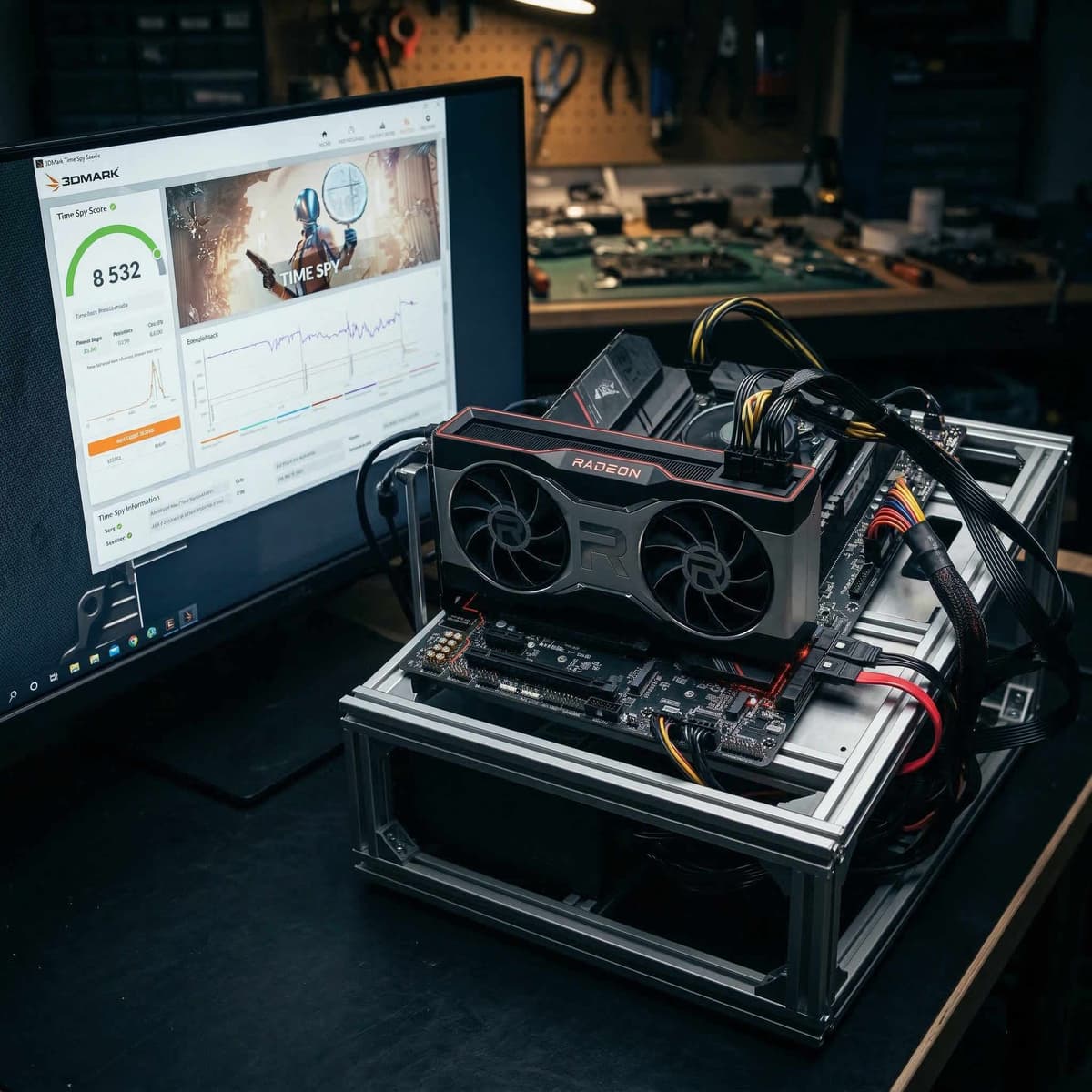
Always stress-test a used card before committing—ten minutes can save you hundreds.
Quick reference: all 10 cards at a glance
| # | GPU | UK Price | Best For | VRAM |
|---|---|---|---|---|
| 1 | RTX 3070 | £180–£220 | All-round value | 8 GB |
| 2 | RX 6700 XT | £140–£175 | Budget 1440p | 12 GB |
| 3 | RTX 3060 Ti | £150–£180 | Entry 1440p | 8 GB |
| 4 | RTX 3080 | £250–£320 | 4K entry | 10 GB |
| 5 | RX 6800 XT | £230–£290 | AMD high-end | 16 GB |
| 6 | RTX 3060 12GB | £115–£145 | Budget 1080p | 12 GB |
| 7 | RTX 4060 | £200–£240 | Efficiency | 8 GB |
| 8 | RX 7800 XT | £310–£370 | Current-gen value | 16 GB |
| 9 | GTX 1660 Super | £55–£75 | Ultra-budget | 6 GB |
| 10 | RTX 4070 | £350–£410 | Buy once | 12 GB |
Final advice: how to buy smart
Whichever card you choose from this list, the buying process matters as much as the pick itself. Here are the rules we live by:
- Always test before committing. Run FurMark or Unigine Heaven for ten minutes and watch for artifacts, crashes, or thermal throttling. Our GPU testing guide has the full process.
- Check completed listings, not asking prices. What a seller wants and what cards actually sell for are often very different. Use eBay's “Sold” filter to see real UK market prices.
- Factor in total system cost. A cheap GPU that needs a PSU upgrade and case swap is not cheap any more. Plan the whole build. Our cheap gaming PC build guide can help.
- Buy from platforms with buyer protection. PayPal Goods & Services, eBay Money Back Guarantee, or a marketplace like Koukan that holds payment until delivery is confirmed.
- Sell your old card. Whatever you are replacing, it has value. Check how much your GPU is worth and put the proceeds toward your upgrade.
Advertisement