Why You Shouldn't Buy a Used AIO Liquid Cooler (And What to Buy Instead)
Advertisement
Browsing UK hardware marketplaces, it is remarkably tempting to pick up a flashy 240mm or 360mm All-in-One (AIO) liquid cooler with RGB fans and an LCD pump screen for £35 to £55. After all, brand-new units from Corsair, NZXT, or Lian Li often retail for well over £120 to £220.
However, amongst professional system builders and experienced hardware engineers, buying a second-hand closed-loop liquid cooler is universally considered one of the most perilous gambles in PC gaming. Unlike a CPU or RAM module—which will function identically whether it is one day or ten years old—an AIO is an enclosed thermodynamic chemical engine undergoing active degradation from the second it is filled at the factory.
The 4 Silent Killers of Second-Hand Liquid Coolers
When you purchase a used AIO on eBay UK or Gumtree, these hidden internal ailments are invisible from the outside:
Molecular Coolant Permeation
Rubber tubes are porous at a sub-microscopic level. Over 2 to 4 years of hot operation, water vapor naturally escapes through the tubing walls. As coolant volume drops, air pockets expand, leading to pump cavitation, gurgling noises, and airlocks in the cold plate.
Cold Plate Micro-Fin Clogging
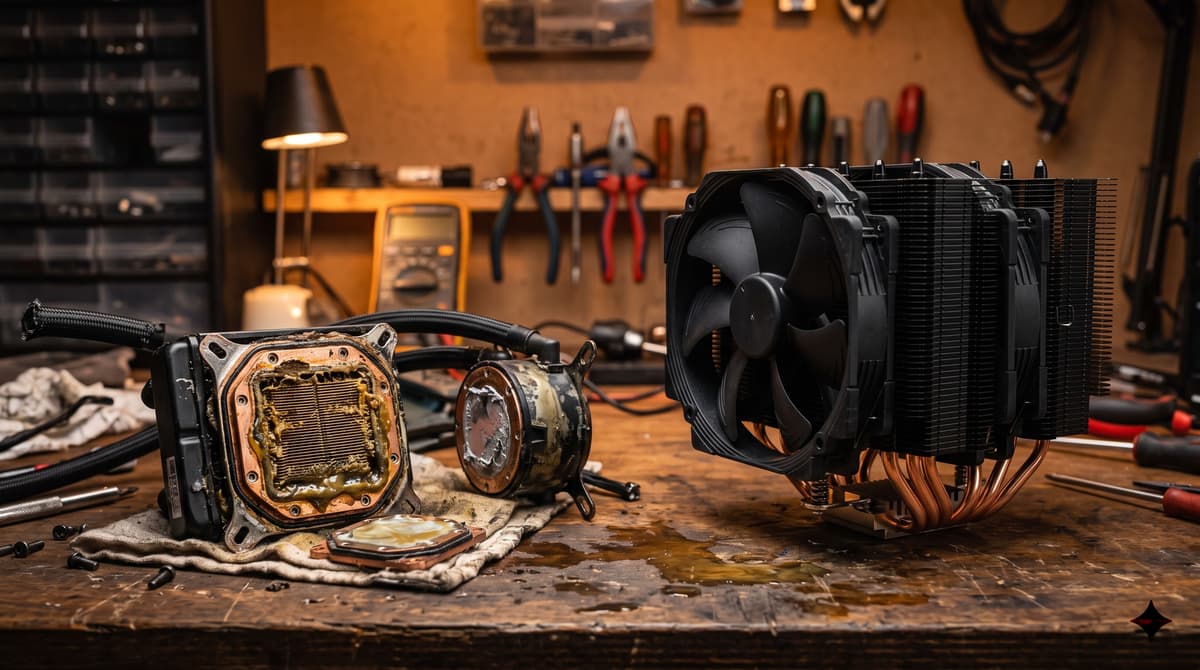
To transfer heat efficiently, copper cold plates feature microscopic slits just 0.1mm wide. Over time, anti-corrosion additives break down, forming a viscous gel or sediment sludge that chokes these micro-fins, destroying thermal transfer completely.
Galvanic Corrosion
Almost all consumer AIOs combine a copper cold plate with an aluminium radiator. While chemical corrosion inhibitors prevent electrochemical galvanic oxidation initially, these inhibitors deplete after 3 years, causing internal flaking and metal pitting.
Ceramic Impeller & Pump Bearing Wear
AIO pumps spin at 2,000 to 4,000 RPM continuously whenever the PC is powered on. Ceramic sleeve bearings wear down, developing play that leads to sudden pump seizure—instantly causing CPU temperatures to spike to 100°C and trigger thermal shutdowns.
Used AIO vs Twin-Tower Air Cooler
| Criterion | Used AIO Liquid Cooler (3+ Yrs Old) | High-End Air Cooler (e.g. Peerless Assassin) | Advantage |
|---|---|---|---|
| Primary Failure Points | Impeller pump, micro-fins gunk, coolant permeation, tube seals | Only the removable fan (heatsink never fails) | Air Cooler (Near zero risk) |
| Expected Lifespan | 3 to 5 years maximum before performance degrades | 15+ years (Swap fan if bearing rattles) | Air Cooler |
| Catastrophic Failure Risk | Liquid leaks dripping onto GPU/motherboard (Fatal) | None (Dry metal fins) | Air Cooler |
| UK Second-Hand Price | £35 – £60 (240mm / 360mm) | £15 – £30 (Single/Twin Tower) | Air Cooler (£20–£30 cheaper) |
| Cooling Performance | Ties or loses to twin-tower if coolant has permeated | Identical to 240mm/280mm AIO under all loads | Tie (when new) / Air wins with age |
For recommendations on safe second-hand cooling hardware, read our companion guide on Buying a Used CPU Cooler in the UK.
The Sensible Alternatives: The Unbeatable Air Champions
Instead of spending £45 on a questionable used liquid cooler, you can purchase brand-new or used top-tier air coolers that outperform most 240mm AIOs for less money:
Seven sintered copper heat pipes, dual aluminium fin stacks, and two 120mm PWM fans. Tames 200W+ heat loads from Core i7-13700K or Ryzen 7 5700X3D with absolute reliability. Zero leaks, zero pumps, zero points of catastrophic failure.
Legendary Austrian engineering. Noctua offers free socket mounting brackets for life when new platforms release; simply provide proof of purchase to Noctua support and they ship you AM5 or LGA1700/1851 kits free of charge.
Checklist If You Absolutely Insist on a Used AIO
- The Slosh Test: Hold the radiator vertical and gently shake it. If you hear a loud, liquid-sloshing sound like a half-empty water bottle, significant permeation has occurred. Avoid it.
- Inspect Radiator Fins: Check for bent or pierced aluminium cooling channels from using overly long mounting screws.
- Barbed Fittings Check: Check where rubber hoses enter the radiator and pump head for green/blue crystalline crust or oily stains.
Frequently Asked Questions
Can I refill a sealed consumer AIO cooler myself?
Most consumer AIOs (Corsair, NZXT, Deepcool) lack fill ports and are factory sealed. While you can technically unscrew the copper cold plate to pour in distilled water and biocide, bleeding air pockets without a reservoir is exceptionally difficult and frequently ruins the rubber gasket seal.
Does manufacturer leak insurance transfer to a second-hand buyer?
No. Companies like Corsair and NZXT offer component damage compensation only to the original purchaser with valid authorized retailer invoice proof. If a used AIO leaks onto your RTX 4080, you bear 100% of the financial loss.
Are custom open-loop liquid cooling parts safer to buy used than AIOs?
Yes. Custom loop components (EKWB, Watercool, Barrow) can be completely dismantled, soaked in vinegar or acid cleaner, fitted with fresh rubber O-rings, and pressure-tested before filling. Closed AIOs offer no such serviceability.
Source Reliable Cooling Gear on Koukan
Trade inspected air coolers, cases, and PC components with full escrow protection. Inspect mounting brackets and fan acoustics safely at home before funds are released.
Advertisement