Is the RTX 4070 Worth Buying Used in the UK in 2026? Our Verdict
Advertisement
Performance-Per-Watt Verdict: April 2026
At £230–270 used, the RTX 4070 is one of the most efficient GPU purchases available in the UK right now. Only 200W under load, DLSS 3 Frame Generation, and 1440p output that still embarrasses cards costing more — this is the Ada Lovelace value story finally maturing.
When NVIDIA launched the RTX 4070 in April 2023 at £599, the reception was lukewarm. The performance was solid but the price was not. Fast-forward to April 2026: the same card now sells used for £230–270 in the UK, and the value story has flipped completely.
With the RTX 50-series Blackwell launch pushing Ada Lovelace off upgrade lists, the secondary market is flooded with well-maintained 4070s from people stepping up to the RTX 5070. That means genuine bargains — but is the RTX 4070 the right buy at this price, or should you chase the RTX 3080 for £220, or stretch your budget and drop to an RX 6800 XT at £190? This guide answers that question with real numbers and honest comparisons.
RTX 4070 Specs: What You Actually Get
The RTX 4070 is built on NVIDIA's Ada Lovelace architecture (TSMC 4nm process). The headline core count and memory bandwidth are competitive, but the real differentiators are power efficiency and feature set — things that matter when you are buying used and running the card for years.
| Specification | Value |
|---|---|
| Architecture | Ada Lovelace (TSMC 4nm) |
| CUDA Cores | 5,888 |
| Memory | 12 GB GDDR6X |
| Memory Bus | 192-bit |
| TDP | 200 W |
| DLSS Generation | DLSS 3 (incl. Frame Generation) |
| Video Encode | AV1 (8th Gen NVENC) |
| PCIe | 4.0 ×16 |
| Launch MSRP (UK) | £599 |
| Used Price (Apr 2026) | £230–270 |
UK Used Price Tracker: April 2026
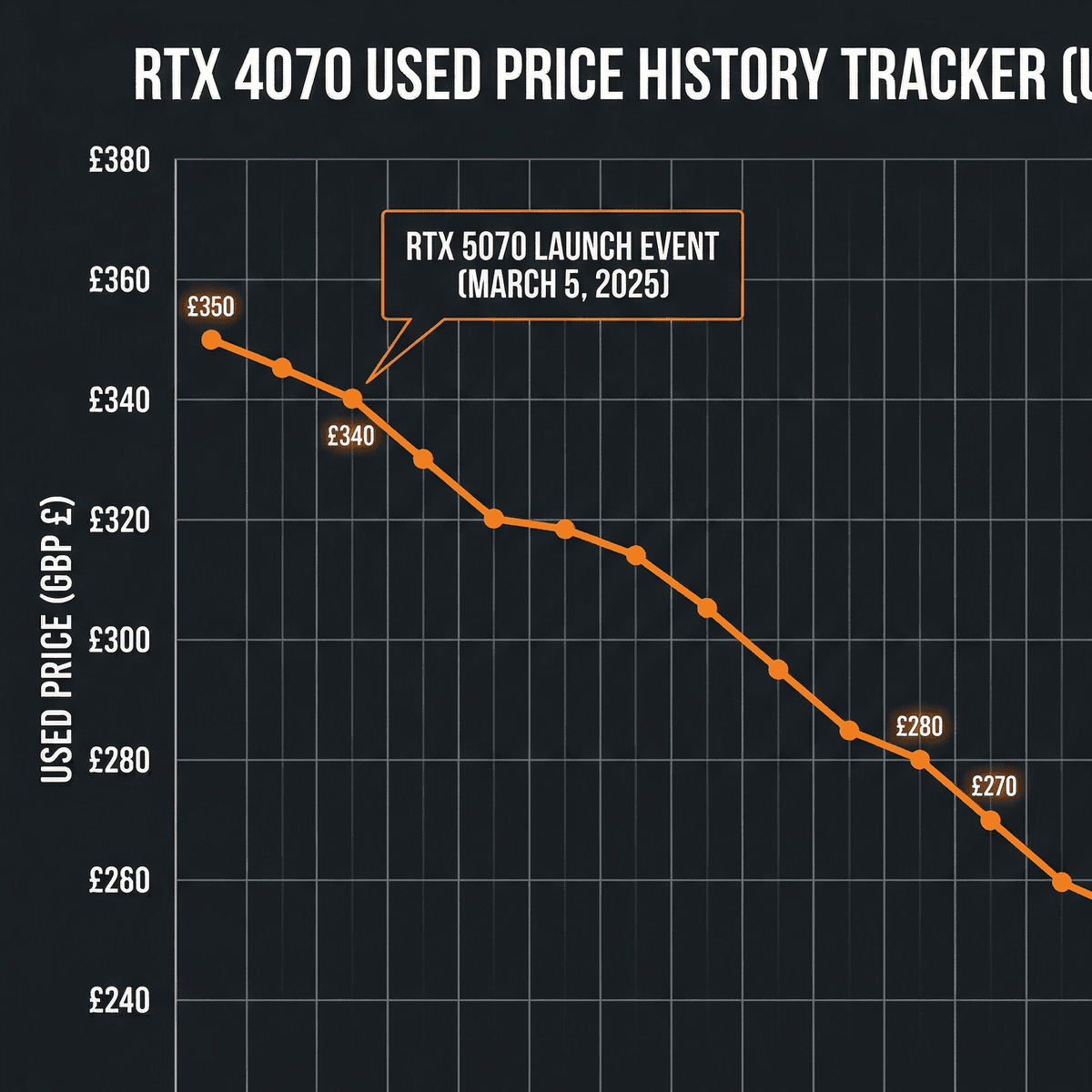
The RTX 4070 launched into a reluctant used market — early listings held stubbornly at £350–380 through mid-2025. The RTX 5070 announcement in late 2025 broke that floor. Prices are now declining consistently, with typical private-sale listings on Koukan sitting at £230–260, and the occasional retail-refurbished unit reaching £270.
Is it still falling? Yes — but slowly. Most analysts expect the RTX 4070 to stabilise at around £210–230 by Q3 2026 as RTX 5070 supply improves. If you are comfortable buying now, you are close to the floor without waiting months. If you can hold out, you might save another £20–30 — but you risk missing available verified stock.
For broader context on how GPU prices move over time, the UK used parts price guide has a full historical breakdown across generations.
1080p Performance: Overkill in the Best Way
At 1080p, the RTX 4070 is complete overkill for 60fps gaming — it delivers well above 100fps in every major AAA title at maximum settings. But “overkill” is exactly what you want for high-refresh gaming. On a 165Hz or 240Hz monitor, the 4070 consistently saturates the panel in competitive titles like CS2, Valorant, and Apex Legends, with frame times that stay flat under pressure.
In heavier games like Cyberpunk 2077 or Alan Wake 2 at 1080p Ultra, you are looking at 90–130fps natively — and well above 200fps with DLSS Quality mode active. For 1080p-only gaming, this card will be relevant for many years without any settings compromises.
1440p Performance: The RTX 4070's True Home
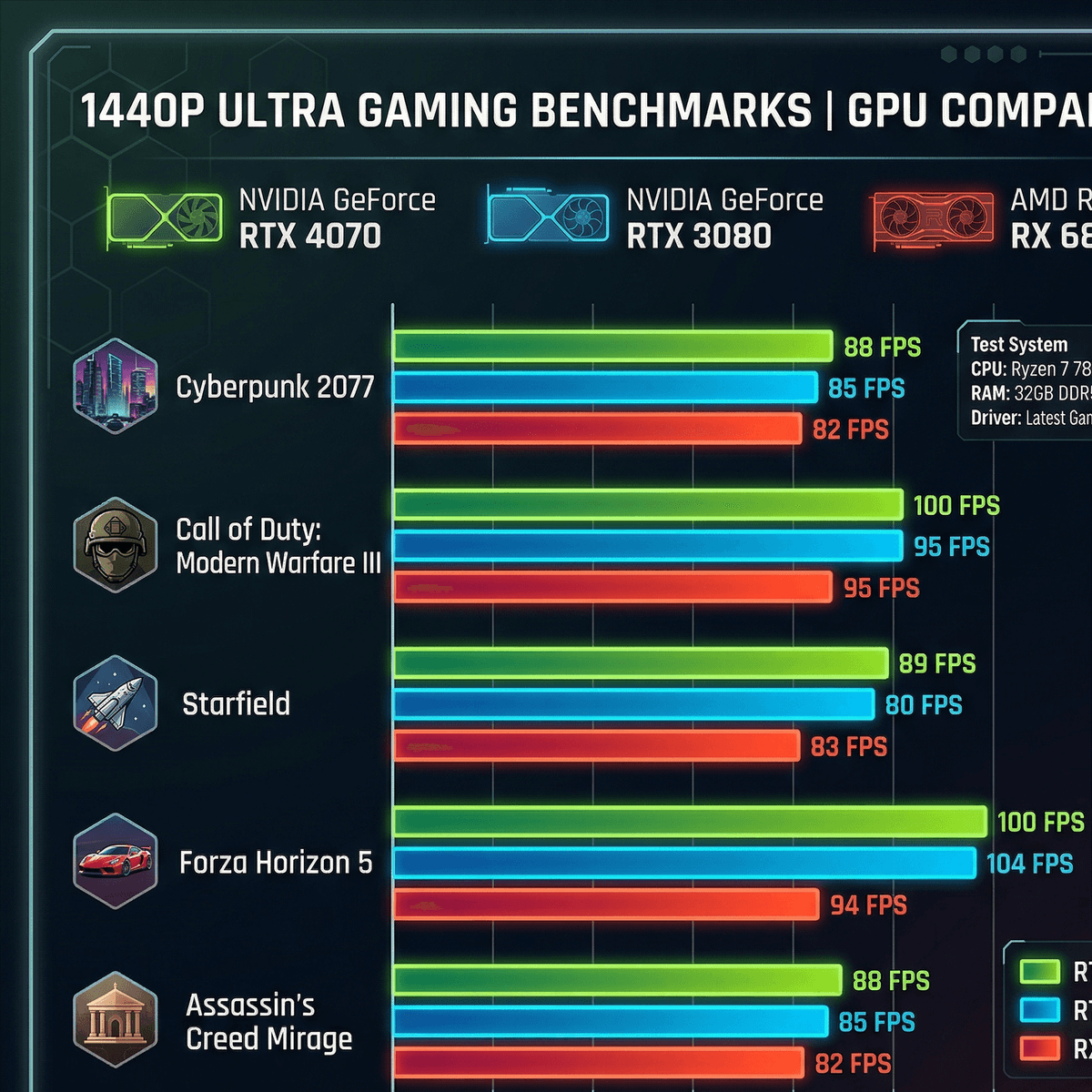
The RTX 4070 was designed for 1440p, and that is exactly where it shines. Expect 80–100fps at Ultra settings in the most demanding AAA titles, climbing to 100–130fps in more optimised or older games. Paired with DLSS Quality mode, you retain almost all visual fidelity while pushing 120fps+ in virtually everything in the current catalogue.
For 1440p 144Hz builds, the RTX 4070 is arguably the best used card at this price range in April 2026. Nothing else at £230–270 matches its combination of raw output, modern feature support, and efficiency at that resolution.
4K Performance: Playable, Not Native
At 4K, the RTX 4070 is playable — but not effortless. Native 4K Ultra in demanding titles typically lands at 45–60fps, which feels smooth for cinematic games but will not satisfy 4K 120Hz ambitions. The saving grace is DLSS Quality mode, which renders internally at 1440p and upscales to 4K with minimal perceptible quality loss, pushing framerates to 70–90fps in most titles.
If you plan to game at native 4K 60fps+ consistently across all modern titles, the RTX 4080 (used ~£550–600) is a more appropriate choice. But for a 4K monitor where 1440p gaming is still your primary resolution, or for casual 4K with DLSS, the RTX 4070 handles it comfortably.
Used Market Comparisons
The RTX 4070 at £230–270 competes directly with three other strong used GPU options in April 2026. Here is how every key metric stacks up, with a clear winner badge on each axis.
vs RTX 3080 (~£220 used)
The Raw Power Alternative
- ✓3080 wins raw raster by ~8–12% at 1440p
- ✗RTX 3080: 320W TDP (vs 200W) — higher running costs
- ✗No DLSS 3 Frame Generation on the 3080
- ✗Older NVENC — no AV1 encode
- →Verdict: 4070 wins on efficiency, features & longevity. 3080 wins raw frames.
vs RX 6800 XT (~£190 used)
The Budget AMD Option
- ✓6800 XT wins raster performance at its price
- ✓6800 XT has 16GB VRAM vs 12GB
- ✗4070 dominates ray tracing (+40–60%)
- ✗No DLSS 3 or AV1 encode on 6800 XT
- →Verdict: 6800 XT if budget is tight; 4070 if you want RT or DLSS.
vs RTX 4060 Ti (~£160 used)
The Cheaper Ada Lovelace Option
- ✗4060 Ti: only 8GB VRAM — pressure in some 1440p titles
- ✗~25–30% slower in rasterisation at 1440p
- ✓Saves ~£70–110 vs the 4070 at current prices
- →Verdict: The 4070 premium is worth it for any serious 1440p gamer.
Power Efficiency: 200W Is a Real Advantage
UK electricity costs make power draw a genuine financial consideration. The RTX 4070's 200W TDP compares favourably to the RTX 3080 (320W) and RX 6800 XT (300W). That 120W difference with the 3080 translates to roughly £35–50 per year in savings at average UK energy rates and typical gaming hours — meaningful over a two or three year ownership cycle.
The 200W limit also means the 4070 is comfortable in small-form-factor cases, doesn't require a premium PSU upgrade, and runs cooler and quieter at load than its Ampere-generation competition. For SFF builds or anyone upgrading from a power-limited system, this matters as much as the frame-rate delta.
Advertisement
Power Draw Comparison — Peak Gaming Load
DLSS 3 & Frame Generation: When It Matters
The RTX 4070 is one of the few used cards under £300 to support DLSS 3 Frame Generation — exclusive to Ada Lovelace and newer GPUs. Frame Generation uses an AI-driven optical flow model to synthesise additional frames between rendered ones, effectively doubling perceived frame rates in supported titles without a proportional CPU or GPU load increase.
In practice, this is transformative in games that explicitly support it. Cyberpunk 2077 at 1440p Ultra goes from 65fps to over 110fps with Frame Generation active — combined with NVIDIA Reflex, the added latency penalty is minimal. Other well-supported titles include Alan Wake 2, Hogwarts Legacy, and an ever-growing list of new releases.
The caveat: Frame Generation works best when your base framerate is already above ~55fps. In competitive shooters where you are chasing 200fps+ with low latency, traditional DLSS Super Resolution (available on RTX 20-series and newer) remains the better tool. For those titles, the RTX 4070 still excels — it just doesn't need Frame Generation to hit high refresh targets.
Content creators benefit from a quieter but significant side feature: the 8th-gen NVENC encoder with AV1 hardware encoding. OBS recordings in AV1 are 40–50% smaller than H.265 at the same visual quality, and streaming to YouTube or Twitch at 1440p becomes genuinely practical without impacting gaming performance.
Who Should Buy the RTX 4070 Used
Ideal Buyer Profile
1440p 144Hz gamers: This is the card built for your setup. Native or DLSS Quality, you will consistently deliver 100–130fps in AAA titles and 200fps+ in esports games.
Upgraders from RTX 2070 or RTX 3060: The performance leap is large and the feature gap is even larger — DLSS 3, AV1 encode, 12GB GDDR6X, and it pulls 80–120W less under load.
Content creators who stream or record: AV1 hardware encode at this price is exceptional value. File sizes halve, stream bitrates halve, and you give nothing up in quality.
Power-conscious builders: If your rig lives in a compact case, runs on a 650W PSU, or you are watching electricity bills, 200W at this performance tier is hard to beat on the used market.
Who Should Look Elsewhere
Consider Alternatives If…
Native 4K 60fps+ across all titles is your goal: Look at the RTX 4080 (used ~£550–600). The 4070 handles 4K with DLSS, but native 4K 60fps in every demanding modern title is not guaranteed.
Maximum raw raster is your only metric: The RTX 3080 at ~£220 edges past the 4070 in native rasterisation by 8–12%. If power draw and DLSS 3 genuinely don't matter to you, it is a cheaper brute-force option.
Our Verdict: April 2026
At £230–270 used, the RTX 4070 is one of the best value GPU purchases available in the UK right now. The combination of Ada Lovelace efficiency, DLSS 3 Frame Generation, 12GB GDDR6X, and AV1 video encode at this price is genuinely hard to beat. The RTX 3080 edges it in raw rasters, and the RX 6800 XT undercuts it substantially — but for 1440p gaming with future-proof feature support and manageable running costs, nothing in this price bracket is a better all-rounder.
We recommend the RTX 4070 used in April 2026. Buy from a seller who can provide photos and a benchmark screenshot showing temperatures under load, pay with buyer protection, and test immediately on arrival. For the verified buying process, see our used GPU buyer's guide and the UK used parts price guide. For a broader comparison across the used market, visit best used GPUs to buy in 2026.
Frequently Asked Questions
Is the RTX 4070 still worth buying in 2026?
Yes. At current used prices of £230–270 in the UK, the RTX 4070 delivers excellent 1440p performance, DLSS 3 Frame Generation exclusive to Ada Lovelace, and a 200W power draw that makes it one of the most efficient options at this performance tier on the used market.
RTX 4070 vs RTX 3080 used — which should I buy?
If raw frame rates are your only metric and power draw doesn't matter, the RTX 3080 at ~£220 wins by a small margin in rasterisation. For most buyers — especially those watching energy bills or wanting DLSS 3 Frame Generation for upcoming titles — the RTX 4070 is the smarter long-term purchase.
How much is a used RTX 4070 in the UK in April 2026?
Used RTX 4070s are selling for £230–270 on UK marketplaces in April 2026. Prices are still gradually declining due to RTX 5070 adoption pressure and are expected to stabilise around £210–230 by Q3 2026.
Can the RTX 4070 run 4K gaming?
Yes, with caveats. The RTX 4070 handles 4K well using DLSS Quality mode (rendering internally at 1440p), achieving 70–90fps across most titles. Native 4K Ultra 60fps is achievable in less demanding games, but for consistent native 4K 60fps+ in all modern AAA titles, the RTX 4080 is a better fit.
What should I check when buying a used RTX 4070?
Always request clear photos of the front, back, and PCIe connector edge. Ask for a benchmark screenshot showing GPU temperatures under load (below 80°C is healthy). Pay via a buyer-protected method and run a stress test on arrival. For the complete step-by-step process, see our used GPU buying guide and how to value your GPU.
Advertisement