Ryzen 7 5800X3D vs 5700X3D: Is 400MHz Worth a £90 Premium on the UK Used Market?
Advertisement
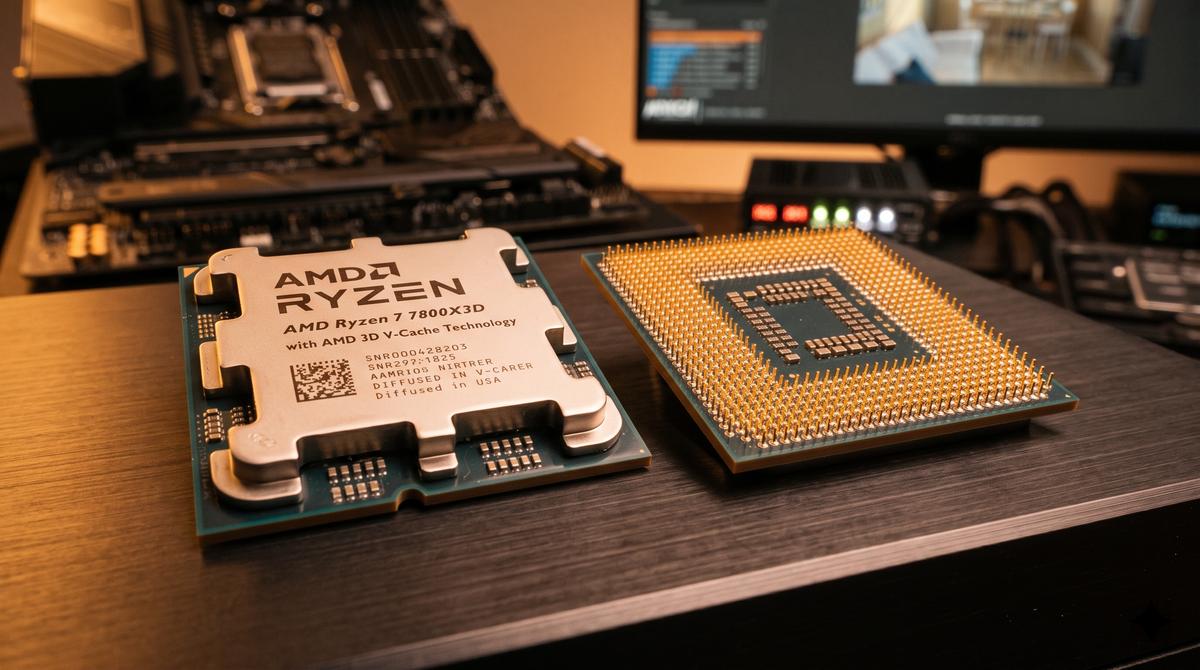
As millions of PC gamers across the UK seek the ultimate send-off upgrade for their socket AM4 motherboards, the market for AMD's 3D V-Cache processors has exploded into two wildly divergent price tiers. The legendary Ryzen 7 5800X3D—discontinued and treated as a collector's grail—now commands between £230 and £260 second-hand on eBay and CeX.
Meanwhile, AMD's late-generation release, the Ryzen 7 5700X3D, features identical 8-core/16-thread Zen 3 architecture, the exact same 96MB of stacked L3 cache, and sells for a modest £140 to £160 used. Does a 400MHz clock deficit justify saving nearly £100? Here is the data-driven answer.
1. Technical Specifications Comparison
| Specification | Ryzen 7 5700X3D | Ryzen 7 5800X3D | Difference |
|---|---|---|---|
| Cores & Threads | 8 Cores / 16 Threads | 8 Cores / 16 Threads | Identical |
| Total L3 Cache | 96MB (32MB + 64MB 3D) | 96MB (32MB + 64MB 3D) | Identical |
| Base Clock | 3.0 GHz | 3.4 GHz | +400 MHz (5800X3D) |
| All-Core Gaming Boost | 4.05 GHz | 4.45 GHz | +400 MHz (~9.8% Clock Lead) |
| Average Used UK Price | £145 – £160 | £235 – £260 | £90 – £100 Cheaper |
2. Gaming Benchmarks: How Much Does 400MHz Matter?
The magic of AMD's 3D V-Cache architecture stems from keeping simulation data, draw calls, and physics calculations inside local on-die SRAM rather than waiting on slower DDR4 system memory. Because latency reduction does the heavy lifting, clock frequency is secondary:
Conclusion: The 5700X3D is the Clear Winner
Paying a 60% price premium (£90–£100) for an average gaming uplift of just 5% to 7% makes zero economic sense. That £90 price differential can buy you a 1TB Gen4 NVMe SSD or upgrade your GPU tier from an RTX 3060 to an RTX 3070. Unless you find a 5800X3D for under £170, the Ryzen 7 5700X3D is unequivocally the smartest CPU upgrade on AM4 today.
Advertisement