How to Avoid Scams When Selling Used PC Parts in the UK
Advertisement
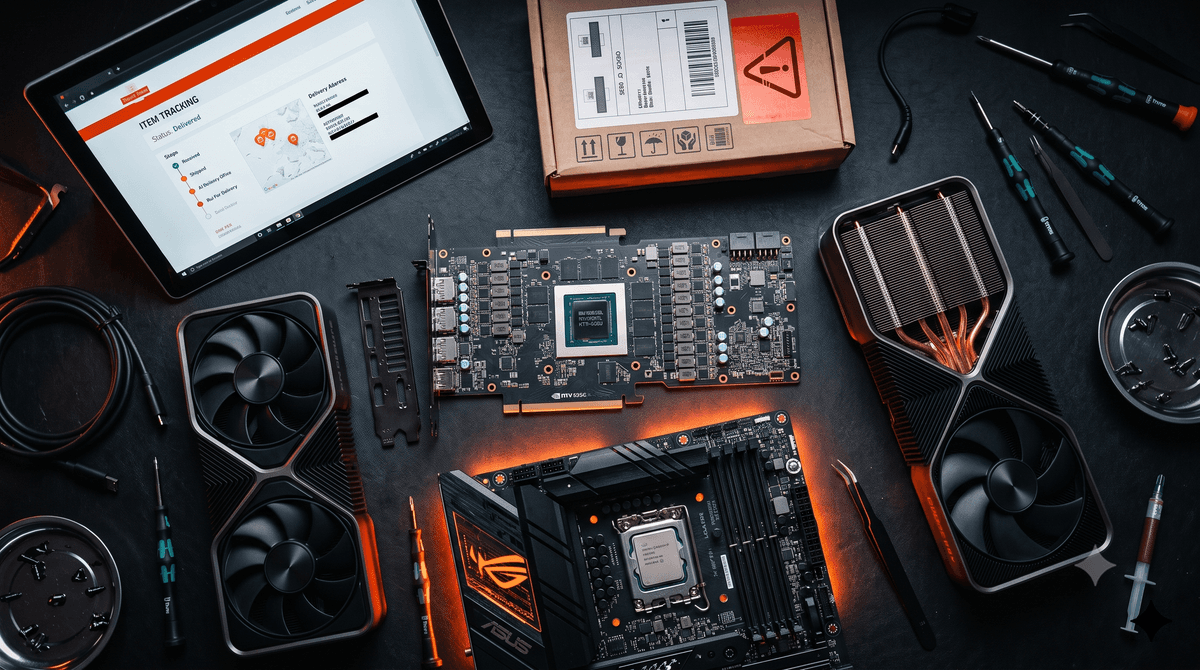
The second-hand PC hardware market in the UK is a double-edged sword. On one side, enthusiasts can recover a substantial portion of their initial build cost by upgrading and selling old components. On the other side, high-value, highly liquid components make PC sellers prime targets for sophisticated buyers seeking to exploit courier tracking loopholes, payment platform dispute policies, or local collection vulnerabilities.
If you want to sell PC parts safely in the UK, you must accept a hard truth: standard marketplace protections are historically heavily weighted in favour of buyers. When you seek to sell pc parts safety uk rules must be built into your transaction flow. An unscrupulous buyer can claim a graphics card arrived dead, swap it with their own broken unit, and request a return. Without a predefined, defensible evidence chain, you will likely lose both the component and the sale funds.
This guide is designed to establish an absolute defence. We will dissect the primary buyer scam vectors active in the UK market—from friendly fraud chargebacks to courier redirection loops—and lay out a step-by-step technical protocol to insulate your transactions from fraud. For the buyer's perspective on trust and marketplace safety, you can also read our companion guide on how to avoid scams when buying used PC parts online.
Establish an undeniable, verifiable link between the working physical component, its serial number, and the shipping parcel before it leaves your hands.
Relying on standard shipping without signature verification, failing to log serial numbers, or moving communication off-platform.
Use Royal Mail Special Delivery for full insurance cover up to £2,500, record packaging sequences, and keep chat logs on-platform.
Why Used PC Parts Are High-Risk Items
To successfully defend your transactions, you must understand why scammers target desktop computer components over other categories of used goods:
- High Liquidity & Immediate Resale: A GPU or CPU can be resold within hours on platforms like eBay, Facebook Marketplace, or quickly liquidated for cash at physical CeX branches across the UK.
- Compact Form Factors: High-value items like an Intel Core i9 processor or a DDR5 RAM kit are tiny. They are easy to pocket, easy to ship, and cheap to return, making mail-order fraud financially highly viable for scammers.
- Technical Complexity as a Smoke Screen: PC parts are sensitive to electrostatic discharge (ESD), require correct installation, and can fail due to user error. Scammers exploit this complexity, claiming a part is dead on arrival (DOA) to initiate returns, knowing platform customer service reps do not possess the technical competence to evaluate if the buyer damaged the item during installation or is outright lying.
- Easy Return Swapping: A buyer purchases an upgrade (e.g., swapping a working RTX 4070 Ti for their own identical but burnt-out RTX 4070 Ti). They claim your card was faulty, open a return, ship back their dead unit, and pocket your fully functional hardware for free.
The 5 Most Common Buyer Scams in the UK Used PC Market
Most scams rely on transaction structures rather than technical hacking. Here are the five most prevalent methods used against UK private sellers:
1. The PayPal Goods & Services Chargeback / Friendly Fraud
The Setup: A buyer agrees to your price and pays via PayPal Goods & Services (or a similar card-processing gateway). You ship the component, tracking confirms delivery, and the transaction seems complete. Weeks later, you receive a notification that the buyer has opened a chargeback with their credit card issuer or PayPal account, claiming "unauthorised transaction" or "item not received".
The Defence: Never ship to an address that does not match the payment profile. Ensure the delivery service requires a physical signature (not just a GPS scan on a doorstep) and matches the name on the transaction record.
2. Return Swapping & Component Harvesting
The Setup: The buyer claims the graphics card or processor is faulty or "not as described" on arrival. They open an official return request. Under most marketplace policies, you are forced to accept the return and provide a shipping label. When the parcel arrives back at your home, the box contains a different, broken component, a lower-spec card with a swapped cooler shroud, or even a brick to match the weight.
In CPU-specific variants, scammers perform "delidding"—removing the metal integrated heat spreader (IHS) of a high-end CPU (like a Ryzen 7 7800X3D) and gluing it onto a cheap, dead CPU (like an ancient Athlon), returning the cheap chip under the premium label.
The Defence: You must record the unique serial number of the printed circuit board (PCB) and system readouts before dispatch. If a return is initiated and the serials do not match, you have concrete evidence to present to the marketplace and the police.
3. The Courier Redirection / Safe Place Loophole
The Setup: You ship the component using a standard tracked service (such as Royal Mail Tracked 24, Evri, or DPD). While the package is in transit, the buyer receives a notification from the courier. They use the courier's app to request "leave in safe place", "deliver to a neighbor", or "redirect to a local pickup shop". Once marked as delivered, the buyer claims they never received it.
The Defence: Use shipping classes that strictly forbid redirection and require a signature directly at the recipient's threshold. Royal Mail Special Delivery Guaranteed by 1pm enforces this by default; the parcel will not be left in a safe place under any circumstances.
4. The Local Meetup Fake Bank App & Counterfeit Cash Scam
The Setup: You list a part for local pickup in London, Manchester, or another UK city to avoid shipping risks. The buyer meets you in person. They inspect the item (such as an RTX 4070 SUPER) and offer to pay via bank transfer (BACS/Faster Payments) or apps like Revolut or Monzo. They type in your details, show you a transaction confirmation screen on their phone showing "Payment Sent", and ask to take the part. You let them go. The money never arrives because they used a dummy bank app designed to simulate transfer screens.
Alternatively, they pay you in paper or polymer cash, but intersperse counterfeit £20 or £50 notes within the stack, hoping you won't count or inspect them in a public, rushed environment.
The Defence: Never hand over hardware based on a screenshot or the buyer's screen. The transaction is only complete when the funds are fully visible on your own banking app, on your own device, showing a cleared balance. Inspect all cash under natural light and feel the raised print on polymer notes.
5. The Phishing / SMS "Payment Received" Spoof
The Setup: The buyer messages you, expressing interest. They ask for your email address or phone number, claiming their marketplace app is glitching or they need to send you a shipping voucher. Shortly after providing it, you receive an email or text message that looks identical to a Koukan or bank notification, stating: "Payment of £380.00 received! Funds will be released to your bank account as soon as you upload a tracking number." You ship the part, only to discover the email was a spoof and no transaction ever occurred.
The Defence: Keep all communications on the platform. Never share your private email, phone number, or bank details in chat threads. Any buyer who insists on moving to WhatsApp or email before buying should be reported immediately. Refer to our guide on marketplace message scams for an in-depth breakdown of these conversational traps.
The Immutable Seller Protection Protocol
To achieve absolute safety when selling PC parts, you must implement a rigorous, repeatable process. Treat this protocol as your operational checklist for every high-value sale.
Phase 1 — Physical and Digital Serialization
Before you list a component, or immediately after a purchase is confirmed, you must document its unique hardware identifiers. This acts as the serial footprint of your component.
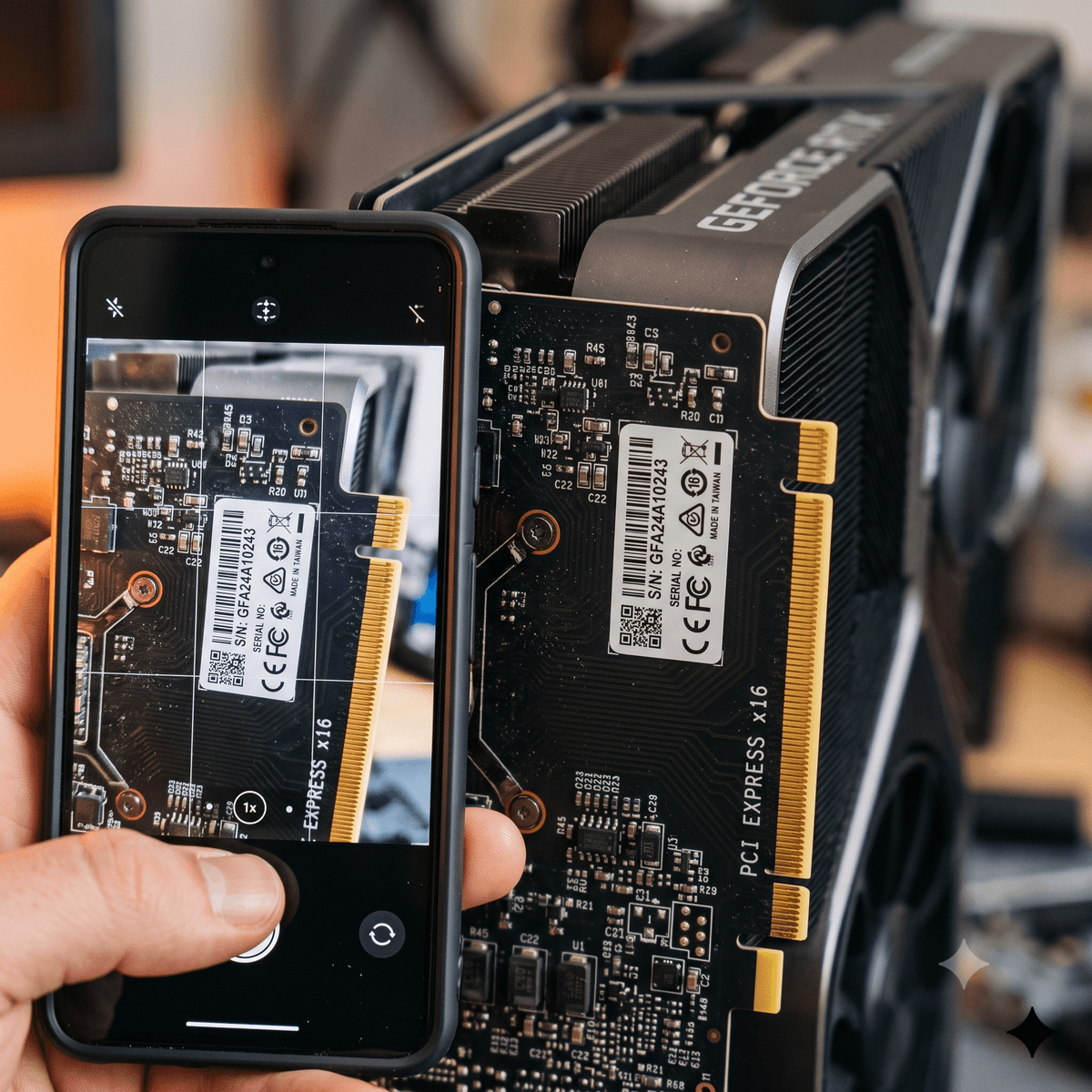
Capture Macro Serial Number Photos
Take a clear, sharp photo of the serial number sticker on the PCB of the card, the backplate, and the retail box. Ensure the barcode is fully readable.
Record Digital Identifiers via Software
Install the part in a test bench or system. Capture screenshots of GPU-Z, CPU-Z, or CrystalDiskInfo (for SSDs) showing the serial numbers of the hardware matching the physical stickers. Take a screenshot of the BIOS screen showing the CPU or Motherboard serial.
Document Performance Benchmarks
Run a 3DMark TimeSpy or FurMark loop for 20 minutes. Take a video or photo of the bench running with the current date, time, and the GPU serial number visible in the frame (e.g., on a sticky note next to the screen). This establishes proof of full functionality.
Phase 2 — The Packing Video Record
If a buyer claims you sent an empty box or a broken part, you need to prove the exact contents of the package when it was sealed.
Set up your phone to record a continuous, unedited video of the packing process. The video must contain:
- The working component showing the serial number sticker clearly in focus.
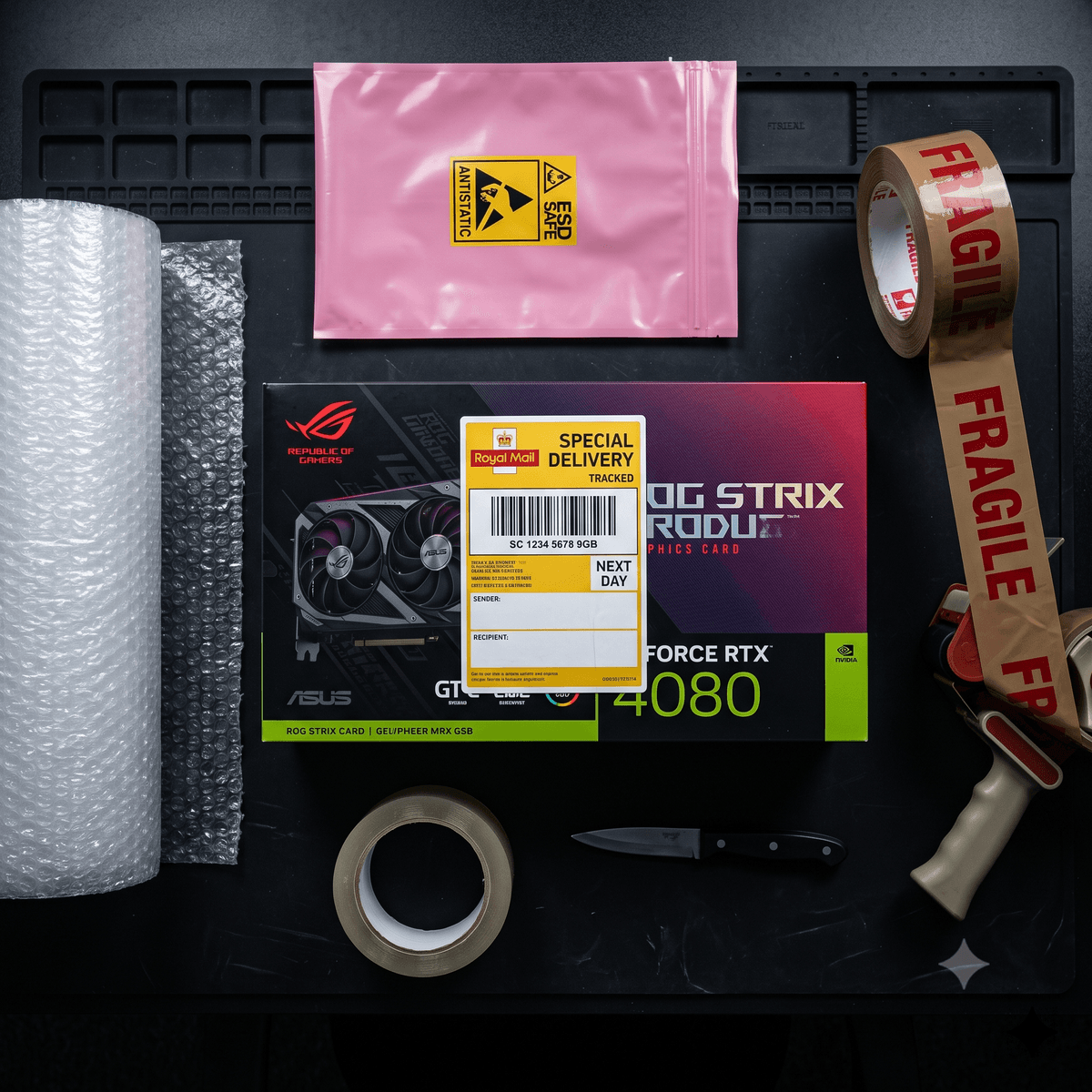
- The component being wrapped in a pink anti-static bag and padded with bubble wrap.
- The component being placed into a sturdy, double-walled cardboard box.
- The box being sealed with high-quality packing tape (ideally custom or branded tape to prevent tamper-swapping).
- The shipping label with the buyer's address and tracking number being applied to the package.
Phase 3 — UK Courier Selection and Insurance
Using the wrong shipping service is the fastest way for a seller to lose money in the UK. If you sell a £600 graphics card and ship it via a basic courier service, you are taking a massive gamble.
| Courier Service | Compensation Limit | Signature Required | Safe Place Policy |
|---|---|---|---|
| Royal Mail Special Delivery | Up to £2,500 (fully covered) | Yes (Mandatory) | No (Never allowed) |
| Royal Mail Tracked 24 / 48 | Up to £150 only | Optional | Allowed at recipient request |
| DPD (Fully Insured Options) | Variable (Up to £5,000 extra) | Yes | Allowed unless restricted |
| Evri / Yodel (Standard) | Default £25 (Max £950 extra) | Optional | Highly permissive |
Why Royal Mail Special Delivery is the gold standard: If a package goes missing or is damaged, Royal Mail Group is highly reliable at processing insurance claims for PC components, provided you have a receipt showing the postage paid and proof of value. Crucially, it is a signed-for physical hand-delivery. If the buyer tries to claim "not received", Royal Mail's GPS-linked signature handover will defeat the claim instantly. Avoid budget couriers for high-value items; the small saving in postage is not worth the risk of a denied insurance claim if the parcel is lost or stolen in transit.
Phase 4 — Local Collection Safe Meetup Protocols
If you decide to sell locally to avoid shipping risks, do not let down your guard. Follow these personal security rules:
- Choose Neutral, Monitored Locations: Do not invite strangers to your home if you are selling highly expensive items like an RTX 4090. Meet inside a bank lobby (which has extensive HD CCTV and security staff), a busy supermarket lobby, or outside a police station.
- Wait for Bank Clearance: If the buyer pays via bank transfer, do not accept screenshots or look at their phone. Open your own bank app. Refresh the balance. Confirm that the exact funds are in your account and marked as "Cleared". Faster Payments clear within seconds; if they say "it might take a few hours", politely tell them you will wait with the item until it clears, or cancel the deal.
- Polymer Cash Verification: If they pay in cash, count the money yourself. Feel the texture of the polymer notes—genuine UK banknotes have raised print and clear window sections with metallic foils. Consider purchasing a cheap UV counterfeit detector pen for £3 from Amazon or a local stationer.
How to Respond to a Dispute or Return Scam
Even with precautions, you may encounter an attempted scam. If a buyer opens a dispute or returns a fraudulent package, you must act immediately to build your defence file.
- Do Not Panic or Argue: Scammers rely on emotional responses to pressure you into making mistakes. Keep your communications professional and fact-focused. Do not make accusations in the chat thread.
- Document the Return Package Immediately: If you receive a returned parcel and suspect fraud, do not open it alone. Take photos of the unopened box from all angles, showing the shipping label, weight markings, and any signs of tampering. Record a continuous video of yourself opening the box, showing the exact item inside and its serial number.
- Compile Your Evidence File: Pull together your pre-shipping bench video, serial number photos, proof of postage receipt (showing package weight), the unboxing video of the returned item, and comparative photos showing the serial numbers do not match.
- Open an Appeal with the Platform: Submit your evidence file to the marketplace customer support. Explicitly state: "The buyer returned a different serial number component than the one sent. The serial number of the sent item was [X], and the returned item is [Y]."
- File an Action Fraud Report: Report the fraud to Action Fraud UK online (actionfraud.police.uk) or by calling 0300 123 2040. Ask for a Crime Reference Number (CRN). Provide the CRN to the marketplace support; platforms take disputes far more seriously once a formal police report is filed.
- Royal Mail Security Escalation: If the buyer used the postal system to commit fraud (e.g., mail fraud by sending an empty box), file a report with the Royal Mail Security team. Mail fraud is a serious crime in the UK.
- Small Claims Court / Money Claim Online: If the platform rules against you and the amount is substantial (e.g., over £300), you can utilize the UK government's Money Claim Online service. A formal "Letter Before Action" sent via recorded delivery to the buyer's shipping address—outlining your evidence and stating you will file a county court claim if the funds are not returned—is highly effective. Scammers often refund immediately to avoid court summons.
Frequently Asked Questions (FAQ)
Is it safer to sell PC parts locally or ship them in the UK?
Both have different risk profiles. Local sales avoid shipping fees, transit damage, and platform chargebacks, but expose you to fake payment screens and personal safety risks. Shipping via protected platforms with Royal Mail Special Delivery provides excellent financial and physical security, provided you document serial numbers and packing sequences.
Does PayPal protect sellers from return swapping?
PayPal's Seller Protection covers "unauthorised transaction" and "item not received" claims if you have tracked proof of delivery. However, it provides very weak protection against "significantly not as described" return swaps. To win these disputes, you must provide police reports (Action Fraud CRN) and clear serialization evidence.
What should I do if a buyer asks to buy off-platform?
Decline immediately. Buyers pushing to move to WhatsApp, Telegram, or bank transfer are almost always trying to strip you of your platform dispute rights. Keeping the transaction inside a dedicated marketplace ensures your communication is logged and your payout is protected.
Can I sue a buyer who scams me in the UK?
Yes. The UK Small Claims Court (Money Claim Online) is a simple, cost-effective way for individuals to recover losses up to £10,000. Because you have the buyer's physical shipping address and tracking data, serving them with court papers is straightforward, and the threat of a county court judgment (CCJ) is a powerful deterrent against fraud. For more details on dispute handling, check out our guide on returns and disputes on Koukan.
Sell Your PC Parts with Complete Security
Koukan was built by PC enthusiasts to eliminate the stress of marketplace selling. Our secure escrow checkout and strict on-platform messaging protect you from the start.
List Your PC Parts on KoukanAdvertisement